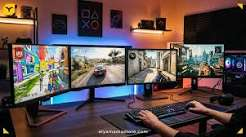
High refresh rate gaming is moving closer to the mainstream as 240Hz monitors become available at prices that would have been difficult to imagine when competitive displays first entered the premium market. Around October 6 and 7, 2026, retailers and manufacturers are promoting a wider range of fast gaming screens, giving competitive players more affordable ways to build responsive setups for titles such as Counter Strike 2, Valorant, Fortnite, and other fast moving games.
240Hz Is No Longer Reserved for Expensive Esports Setups
For years, a 240Hz gaming monitor was largely associated with serious enthusiasts and professional esports players. The combination of a fast panel, low response time, adaptive synchronization, and a powerful computer often required a significant investment. That picture is changing as manufacturers bring high refresh rate technology into lower price categories.
Current market testing shows how far that shift has progressed. RTINGS reports that 240Hz monitors are now available across several resolutions and price levels, including affordable 1080p models for systems that may struggle to maintain very high frame rates at higher resolutions. Its testing also highlights an important point for buyers: the value of a 240Hz display depends heavily on whether the computer can actually produce enough frames to take advantage of it.
That distinction matters because the number printed on the monitor box is only part of the experience. A 240Hz screen refreshes the image every 4.17 milliseconds, but a computer producing 100 frames per second cannot provide 240 unique frames every second. The strongest results appear when the graphics system and display are capable of working together at consistently high frame rates.
The Price Barrier Is Falling Across the Gaming Monitor Market
The most important change is not simply that 240Hz technology exists. It is that consumers can now find high refresh rate displays without automatically entering the premium price segment. Current retail comparisons show 240Hz models appearing below the prices traditionally associated with enthusiast gaming monitors.
PC Gamer’s October 2026 monitor coverage shows how quickly pricing has changed across the broader display category. Budget buyers can now find high refresh rate screens at prices that leave more of their hardware budget available for a graphics card, processor, memory, or storage.
This creates an important opportunity for younger players and aspiring esports competitors. A student who previously had to choose between an expensive display and a stronger graphics card may now be able to build a more balanced setup. A player competing from a smaller room or shared home can also achieve a competitive style of display performance without buying equipment designed exclusively for professional tournament environments.
Affordable Does Not Always Mean Slow
The expanding budget category does not mean every inexpensive 240Hz monitor delivers identical performance. Panel response, input latency, motion clarity, resolution, adaptive synchronization, brightness, color reproduction, and overdrive behavior can differ substantially between models.
A monitor can advertise 240Hz while still producing visible ghosting if its pixels cannot transition quickly enough. This is why buyers should look beyond refresh rate when comparing esports displays. Independent testing can reveal whether a monitor actually maintains good motion performance across different refresh rates and response settings.
For competitive gaming, this matters during the moments that happen in fractions of a second. When a player quickly turns toward an opponent, follows a moving target, or reacts to an unexpected angle, clean motion can make the scene easier to read. The monitor cannot replace skill, but a poorly performing display can introduce an unnecessary limitation.
Why 240Hz Matters for Competitive Players
The jump from 60Hz to 144Hz is generally much more dramatic than the jump from 144Hz to 240Hz, but the higher refresh rate still provides a smoother visual experience when the computer can sustain the necessary frame rate. Competitive players who spend hundreds of hours practicing the same movements may notice those differences more than casual users.
The benefit is especially relevant in games where rapid camera movement and precise aiming are central to the experience. A faster display can provide more frequent visual updates, which may make target tracking feel more natural and reduce the perceived delay between player input and what appears on screen.
RTINGS describes 240Hz displays as particularly useful for competitive gaming because of their smoother presentation during fast action. The organization also stresses that buyers should match the display to their computer rather than simply choosing the highest refresh rate available.
1080p Remains Important for Budget Esports Systems
One of the reasons 240Hz technology can move into lower price categories is that manufacturers do not need to pair it with extremely high resolution. A 1080p 240Hz display places a considerably lower graphics demand on a computer than a 4K 240Hz display.
That makes Full HD an attractive option for competitive players who prioritize frame rate and responsiveness over cinematic image quality. A reasonably capable gaming computer may be able to produce very high frame rates at 1080p in competitive games, while the same system could struggle to reach those numbers at 1440p or 4K.
For someone building an esports focused computer on a limited budget, this can be a sensible approach. Spending less on resolution while investing in a strong processor, capable graphics hardware, and a fast monitor may produce a better competitive experience than buying an expensive high resolution display that the computer cannot drive effectively.
1440p 240Hz Is Becoming More Interesting Too
The market is not stopping at 1080p. More 1440p 240Hz monitors are entering value oriented price ranges, creating a new option for players who want both competitive speed and sharper image quality.
A 1440p 240Hz monitor requires more graphics performance, so it is not automatically the best choice for every buyer. But for players with a sufficiently powerful graphics card, it can provide a useful balance between esports responsiveness and visual detail.
This is where the budget monitor market becomes more interesting. Consumers are no longer choosing only between a basic 60Hz office monitor and an expensive professional esports display. There is now a much wider range of combinations involving resolution, refresh rate, panel technology, screen size, and price.
OLED Is Changing the Premium End While IPS Drives Wider Adoption
Panel technology is another major factor behind the changing monitor market. OLED displays are known for extremely fast pixel response and strong contrast, making them attractive to gamers who want both competitive performance and high image quality. However, OLED monitors have historically occupied a more expensive segment.
IPS technology remains important because it can offer fast response, good viewing angles, and strong image quality at more accessible prices. For many esports players, a fast IPS panel may represent a more sensible investment than an expensive OLED model if the primary goal is competitive performance.
The market is therefore developing at both ends. Premium displays are pushing refresh rates far beyond 240Hz, while affordable models are bringing 240Hz performance to a much larger audience. PC Gamer recently reported on an AOC display capable of an extraordinary 1,000Hz refresh rate, illustrating just how quickly the upper limits of monitor technology are moving.
Higher Refresh Rates Are Not Automatically Better for Everyone
The arrival of cheaper 240Hz monitors should not encourage every gamer to replace a perfectly good display. The right purchase depends on the games being played, the computer producing the frames, and the player’s priorities.
A person who mostly plays strategy games, watches movies, works with documents, or uses creative applications may gain more from higher resolution, stronger color accuracy, better ergonomics, or a larger screen. A competitive shooter player may reasonably prioritize refresh rate and motion clarity instead.
There is also a point of diminishing returns. Once refresh rates move substantially beyond 240Hz, the improvement between generations becomes increasingly subtle for ordinary users. Professional players may pursue every measurable advantage, but most consumers should consider whether their computer and gaming habits justify the additional cost.
What Buyers Should Check Before Choosing a Budget 240Hz Monitor
Consumers looking for an affordable esports display should examine the complete specification rather than focusing on the refresh rate alone. A practical checklist includes:
- Check whether the computer can consistently produce high frame rates in the games being played.
- Look for independently measured input latency and pixel response performance.
- Confirm that the desired refresh rate is supported through the chosen DisplayPort or HDMI connection.
- Compare adaptive synchronization support for the graphics card being used.
- Consider 1080p for lower cost systems and 1440p when the graphics hardware can support it.
- Check the monitor stand and adjustment options if it will be used for long gaming sessions.
- Compare warranty coverage and panel quality rather than choosing solely on the lowest price.
Affordable Esports Hardware Could Broaden Competitive Gaming
The significance of cheaper 240Hz monitors extends beyond the monitor industry. Competitive gaming depends on access to hardware, and the cost of that hardware can influence who gets the opportunity to practice seriously.
A player does not need professional equipment to become skilled, but access to a responsive display can remove one technical limitation. When high refresh rate monitors become affordable in more regions, schools, gaming communities, local esports clubs, and individual players can build capable setups without the same financial burden faced by earlier generations.
That does not eliminate the wider costs of competitive gaming. A capable computer, stable internet connection, peripherals, electricity, and game access still matter. However, reducing the price of one major component can make the overall entry point more manageable.
The New Esports Monitor Standard Is About Balance
The October 2026 market shows a clear change in how gaming monitors are being positioned. The question is no longer simply whether a player can afford a 240Hz display. The more useful question is which combination of refresh rate, response time, resolution, panel technology, graphics performance, and price makes sense for that player’s actual needs.
For competitive players, 240Hz is becoming a realistic target rather than a luxury specification. For manufacturers, that means the pressure is shifting toward better performance at lower prices. For consumers, it creates more choice and makes careful comparison more important.
We are entering a period when a serious esports setup does not necessarily require premium equipment at every stage. A well chosen 240Hz monitor, paired with hardware capable of sustaining high frame rates, can provide the responsiveness many competitive players are seeking without forcing them into the most expensive part of the market. That broader accessibility may ultimately be the most important development of all, because better technology matters most when more people have a genuine opportunity to use it.