Travelers arriving in Italy from Spain are facing temporary document checks at airports and seaports after Rome reinstated internal Schengen border controls on August 1. The measure, announced by Italy’s Interior Ministry and still in force on August 5, is expected to continue through the month as Italian authorities respond to a large migration movement into Ceuta, Spain’s North African enclave.
What travelers should expect
Italy is conducting targeted and selective checks rather than imposing a permanent closure of its air and sea connections with Spain. Border police have been checking passengers at major arrival points, including Rome Fiumicino, Milan Malpensa and Milan Linate, while similar procedures apply to maritime routes connecting the two countries.
[brusselssignal](https://brusselssignal.eu/2026/08/airport-signs-mark-italys-unilateral-schengen-suspension-on-spanish-arrivals/)
Flights and ferry services are continuing to operate. The main change is that passengers who previously moved between two Schengen countries without a routine passport inspection may now be directed toward a border control area and asked to show proof of identity or immigration status.
Travelers should carry the documents that establish their right to enter or move through the Schengen area. A valid passport, residence permit or visa may be required, depending on nationality and personal circumstances. The United States Embassy in Madrid advised American travelers to expect possible screening, document verification and delays when arriving in Italy from Spain.
[es.usembassy](https://es.usembassy.gov/message-for-u-s-citizens-u-s-embassy-madrid-spain-august-5-2026-temporary-reinstatement-of-border-controls-on-arrivals-to-italy-from-spain/)
Passengers should also allow additional time for connections, baggage collection and onward rail travel. Even a short inspection can create longer lines when a full aircraft arrives at the same time, particularly during the busy summer travel period.
Who is most likely to be checked
The Italian government has said the controls are aimed especially at people who are not citizens of the European Union. Officials want to verify that those travelers hold the documents required to circulate legally within the Schengen area. Spanish citizens and citizens of other European Union countries were initially not expected to face the same level of scrutiny, although all passengers should keep valid identification available.
[nationthailand](https://www.nationthailand.com/news/world/40069280)
Travelers who are legally present in Spain but continuing to Italy should pay close attention to the documents connected with their status. A passport alone may not show the full basis for residence or travel rights. A valid residence permit, visa or other supporting document can help clarify the traveler’s situation if an officer asks additional questions.
Rules can be applied differently at individual airports and ports, and operational instructions may change during the temporary period. Passengers should check with their airline, ferry company and the relevant airport before leaving for the terminal. The official information page for Venice Marco Polo Airport confirms that random checks have been restored for arrivals from Spain while flights continue to operate normally.
Why Italy brought back the checks
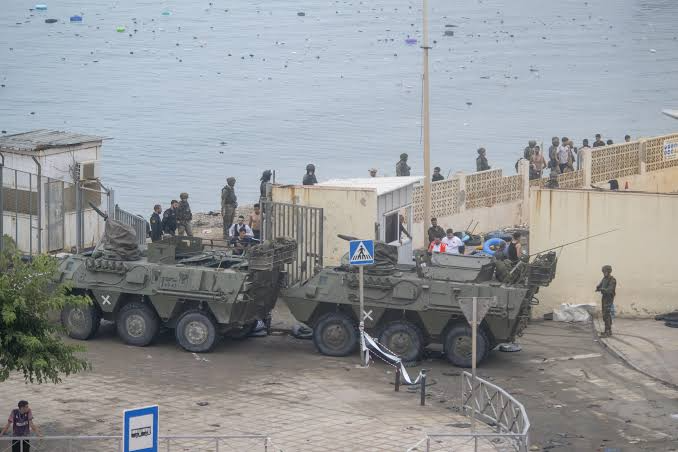
Italy’s decision followed the arrival of tens of thousands of migrants in Ceuta from neighboring Morocco. The episode placed pressure on Spain and raised concerns in Rome about the movement of people from Spain into other parts of the Schengen area. Italy presented the measure as a temporary security and migration response rather than a decision to permanently exclude Spain from the border free travel system.
Ceuta is a Spanish territory on the North African coast, separated from mainland Spain by the Mediterranean Sea. Because Italy and Spain do not share a land border, the practical effect of Rome’s action is concentrated at airports and seaports. People traveling between the countries by road through France are not affected by the Italian checks in the same way.
Italian Interior Minister Matteo Piantedosi said the controls would remain in place for the time necessary, with particular attention to limiting the effect on summer tourism. Prime Minister Giorgia Meloni also described the step as temporary.
[euronews](https://www.euronews.com/my-europe/2026/08/02/italy-brings-in-border-checks-for-arrivals-from-spain-what-changes)
This is not Spain leaving Schengen
The announcement has sometimes been described as Italy suspending Schengen travel with Spain, but that wording can create confusion. Italy has not removed Spain from the Schengen area, and the European border free system has not ended for all travel between the two countries.
Schengen rules allow member states to restore internal border checks in response to a serious threat to public policy or internal security. Those controls are meant to be temporary, proportionate and limited to the situation that prompted them. Italy has used that mechanism for selected air and sea routes instead of ending the wider arrangement.
For ordinary travelers, the distinction is still important. A Spanish passport holder may continue to travel under European free movement rules, but a passenger arriving from Spain can still encounter police checks at an Italian airport. A non European traveler may need to show both identity documents and proof of lawful movement within the Schengen area.
Possible effects on summer travel
August is one of the busiest travel months in Europe. Families move between coastal destinations, students return home, workers take annual leave and ferry terminals handle large numbers of passengers. The return of checks can add stress to journeys that already involve tight connections, crowded terminals and long waits beside baggage belts.
Airport operators have said schedules are continuing as planned, but normal flight operations do not guarantee that every passenger will move through arrivals at the usual speed. The additional checks may create separate queues or redirect passengers through areas normally used for non Schengen arrivals. At some airports, people have reported longer waits for baggage after aircraft from Spain were routed through adjusted arrival areas.
[brusselssignal](https://brusselssignal.eu/2026/08/airport-signs-mark-italys-unilateral-schengen-suspension-on-spanish-arrivals/)
Travelers with connecting flights should consider a larger time margin than usual. Those carrying children, medical equipment or mobility aids may benefit from contacting the carrier before departure. Anyone who must attend a meeting, board a train or reach a cruise departure should avoid planning the connection too closely around the scheduled landing time.
What visitors should do before departure
- Carry a valid passport or identity document in an accessible place.
- Bring a valid visa, residence permit or other proof of lawful travel when required.
- Check the latest instructions from the airline, ferry operator and arrival airport.
- Allow extra time for document checks, baggage collection and onward travel.
- Keep digital copies of important documents in a secure location, while carrying the originals when required.
- Contact the relevant embassy or consulate if immigration status is unclear.
Travelers should not rely only on a photograph of a document stored on a phone. Digital copies can help during an emergency, but border officers may require the original passport, permit or visa. A person who has lost a passport or residence card should contact the issuing authority before traveling rather than assume that a carrier or border officer can resolve the problem at the airport.
A test for Europe’s open travel system
Italy’s action illustrates the tension within the Schengen area. Open internal borders make travel easier for residents, workers and tourists, but they also depend on cooperation among national authorities. When one country believes that a serious migration or security risk requires additional screening, temporary checks can return quickly.
For travelers, the political debate becomes visible through signs, passport queues and questions from border officers. For governments, the challenge is to respond to genuine risks without creating confusion, discrimination or unnecessary disruption. Selective checks can be more limited than a blanket inspection of every passenger, but they still require clear guidance and consistent application.
The European Commission’s official information on the Schengen area provides background on border rules and the temporary measures available to member states. Italy’s foreign ministry also provides consular guidance through its official website.
What happens next
The controls are expected to remain temporary and focused on arrivals from Spain by air and sea. Their continuation will depend on the Italian government’s assessment of the migration and security situation, as well as any further notification under Schengen rules.
For now, flights and maritime links remain open, but the experience at arrival has changed. The best protection for travelers is preparation: carry the correct documents, expect possible delays and check current instructions before leaving. Italy has reinstated a layer of scrutiny that many passengers had not expected to see inside Europe, and even a short term measure can have a real effect on the pace and atmosphere of summer travel.