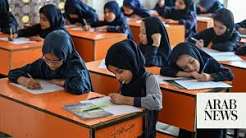
Five years after the Taliban seized control of Afghanistan, UNESCO has issued an urgent global appeal for the immediate and unconditional restoration of secondary and higher education for women and girls. As of August 2026, an estimated 2.4 million Afghan girls remain locked out of classrooms, with the United Nations agency warning that the ban risks condemning an entire generation to lost potential, deepening poverty, and irreversible socio-economic harm.
[unesco](https://www.unesco.org/en/articles/five-years-unesco-calls-full-restoration-right-education-afghan-girls-and-women)
A Nation Alone in Banning Girls’ Education
Afghanistan now stands as the only country in the world where girls and women are formally prohibited from attending secondary schools and universities. The Taliban authorities first closed secondary schools for girls in March 2022, then extended the ban to universities in December of the same year, despite earlier promises to allow girls to continue their education under Islamic principles.
[dw](https://www.dw.com/en/afghanistan-school-ban-girls-taliban-unesco/a-78328926)
The United Nations has described these sweeping restrictions on Afghan women as a form of “gender apartheid,” marking a systematic erasure of women’s public presence and participation. UNESCO’s Director-General and senior officials have repeatedly emphasized that the right to education cannot be negotiated or compromised, calling on the international community to maintain diplomatic pressure until schools and universities reopen to all Afghan girls and women.
[abcnews](https://abcnews.com/International/wireStory/24-million-afghan-girls-shut-secondary-school-5-135551092)
The Human Cost of a Five-Year Ban
UNESCO’s latest assessment reveals that the number of girls excluded from secondary education has grown by approximately 200,000 over the past year alone. If current policies remain unchanged, the agency warns that nearly four million girls could be denied secondary education by 2030.
[dw](https://www.dw.com/en/afghanistan-school-ban-girls-taliban-unesco/a-78328926)
For many Afghan families, the ban has shattered dreams and altered life trajectories. Girls who once excelled in mathematics, science, and literature now spend their days confined to their homes, unable to pursue the futures they once imagined. Teachers, many of them women who lost their livelihoods, describe the silence in classrooms that once buzzed with youthful energy.
[gazettengr](https://gazettengr.com/taliban-stopped-2-4-million-girls-from-going-to-school-in-afghanistan-unesco/)
“Five years is not a temporary interruption in a child’s education,” said Hoda Jaberian, UNESCO’s program coordinator for education in emergencies. “It is clearly almost an entire secondary school cycle.”
[dw](https://www.dw.com/en/afghanistan-school-ban-girls-taliban-unesco/a-78328926)
Long-Term Economic and Social Consequences
Beyond the immediate human toll, UNESCO estimates that excluding women from secondary and higher education could push around 600,000 Afghan women out of the workforce by 2066. The cumulative income losses are projected to reach $9.6 billion, further entrenching poverty and limiting the country’s capacity for recovery and growth.
[dw](https://www.dw.com/en/afghanistan-school-ban-girls-taliban-unesco/a-78328926)
The ban also increases the risk of early marriage, as girls with no access to schooling face fewer alternatives and diminished prospects for economic independence. Communities that once saw girls graduate and enter professions such as teaching, healthcare, and engineering now face a future where those pathways are closed.
[dw](https://www.dw.com/en/afghanistan-school-ban-girls-taliban-unesco/a-78328926)
UNESCO stresses that protecting the right to education for all Afghans is not only a moral imperative but a strategic necessity for the nation’s long-term stability and prosperity.
[unesco](https://www.unesco.org/en/articles/five-years-unesco-calls-full-restoration-right-education-afghan-girls-and-women)
UNESCO’s Call to Action
In a statement released on August 11, 2026, UNESCO condemned discrimination against women and girls and called for the immediate and unconditional restoration of their right to education. The agency reiterated that face-to-face learning in a classroom remains the most effective way for children to learn, and that there is no substitute for formal schooling.
[unesco](https://www.unesco.org/en/articles/five-years-unesco-calls-full-restoration-right-education-afghan-girls-and-women)
While UNESCO continues to support alternative learning opportunities through community-based literacy programs, skills development initiatives, and psychosocial support, these efforts cannot replace the structure, certification, and social benefits of formal education.
[gazettengr](https://gazettengr.com/taliban-stopped-2-4-million-girls-from-going-to-school-in-afghanistan-unesco/)
The agency urged all countries to maintain diplomatic pressure on Afghanistan’s de facto authorities and to relentlessly demand the reopening of schools and universities to girls and women. UNESCO also called on the international community to sustain investment in foundational education and to expand inclusive learning opportunities for Afghan girls and women wherever possible.
[abcnews](https://abcnews.com/International/wireStory/24-million-afghan-girls-shut-secondary-school-5-135551092)
What the World Can Do
For governments, donors, and civil society organizations, the path forward requires sustained advocacy, targeted funding, and creative solutions that keep learning alive even under severe restrictions. Key actions include:
[unesco](https://www.unesco.org/en/articles/five-years-keeping-learning-alive-girls-and-women-afghanistan)
- Maintaining diplomatic engagement with Afghan authorities to press for the unconditional reopening of schools and universities to girls and women.
- Supporting community-based education initiatives that provide safe, accessible learning opportunities for girls at the local level.
- Investing in teacher training, curriculum development, and educational materials that can be used in informal and alternative learning settings.
- Advocating for the protection of female educators and students from harassment, intimidation, and violence.
[abcnews](https://abcnews.com/International/wireStory/24-million-afghan-girls-shut-secondary-school-5-135551092)
[gazettengr](https://gazettengr.com/taliban-stopped-2-4-million-girls-from-going-to-school-in-afghanistan-unesco/)
[unesco](https://www.unesco.org/en/articles/new-report-warns-afghanistans-education-crisis-threatens-future-entire-generation)
[unesco](https://www.unesco.org/en/articles/banned-education-review-right-education-afghanistan)
UNESCO’s official statement underscores that gender equality remains a strategic priority for the organization, and that the world must not look away until the human rights of Afghan girls and women are fully restored.
[unesco](https://www.unesco.org/en/articles/five-years-unesco-calls-full-restoration-right-education-afghan-girls-and-women)
A Future Worth Fighting For
Behind the statistics are millions of individual stories: a girl who once dreamed of becoming a doctor, a young woman who aspired to teach, a mother who hoped her daughters would have opportunities she never had. The ban on education has not only denied them classrooms; it has denied them agency, voice, and the chance to shape their own futures.
[gazettengr](https://gazettengr.com/taliban-stopped-2-4-million-girls-from-going-to-school-in-afghanistan-unesco/)
As UNESCO marks five years since the Taliban’s return to power, the message is clear: Afghanistan’s girls and women have the right to learn, to work, to move freely, and to participate fully in society. The cost of inaction is too high, and the time to act is now.
[unesco](https://www.unesco.org/en/articles/five-years-unesco-calls-full-restoration-right-education-afghan-girls-and-women)