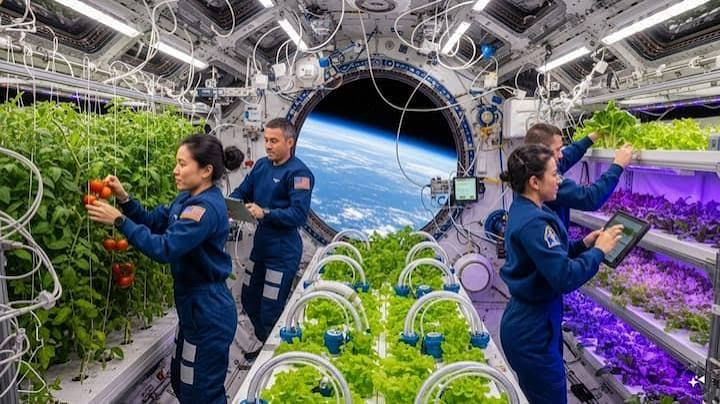
From rice and wheat to other crops that sustain communities across continents, the foods that fill everyday kitchens are becoming part of a much larger scientific question: can humanity grow reliable supplies of food beyond Earth? On October 9, 2026, reports about researchers sending key regional crops and staple foods into space test environments brought renewed attention to the challenge of feeding future space explorers. The research aims to examine how familiar food crops respond to unusual growing conditions, while exploring whether agricultural systems can withstand the environmental pressures of missions to the Moon, Mars, and potentially other worlds.
Why Staple Foods Are Becoming Part of Space Research
Food is one of the most fundamental requirements for human life, whether a person is living in a crowded city, working on a remote research station, or traveling beyond Earth. Space missions make that requirement particularly difficult to meet. Supplies launched from Earth have limited storage capacity, transportation costs are substantial, and long journeys create logistical challenges that become more serious as destinations move farther away.
Growing food during a mission could help reduce dependence on repeated deliveries. Plants can potentially provide fresh produce, contribute to a varied diet, and support a more sustainable system for long duration exploration. However, the process involves much more than placing seeds in soil and supplying water. Researchers must determine whether crops can grow under altered gravity, controlled lighting, restricted growing space, and carefully managed supplies of nutrients and water.
The reported tests involving regional crops and staple foods reflect an important research priority: identifying plants that people already know how to cultivate and prepare. A crop that performs well in a laboratory but offers little nutritional value, requires excessive resources, or cannot become part of a practical meal may have limited usefulness for future missions.
What Scientists Hope to Learn From Space Test Environments
Space related agricultural experiments can examine several conditions that differ significantly from those on Earth. Some studies use specialized ground facilities to reproduce aspects of the space environment, while others investigate plant responses during actual spaceflight. These approaches answer different questions, and a successful test in one setting does not automatically demonstrate that a crop can be cultivated on the Moon or Mars.
How Plants Respond to Altered Gravity
Gravity influences how roots grow, how shoots orient themselves, and how plants respond to their surroundings. In reduced gravity, familiar biological signals can change, potentially affecting root development and the movement of water and nutrients. Researchers need to establish whether staple crops can maintain healthy growth when these natural cues are altered.
Water management presents another challenge. On Earth, gravity helps move water through soil and growing containers. In microgravity, liquids behave differently, making it necessary to design systems that deliver moisture and nutrients without allowing water to collect in harmful ways or escape into equipment. The success of space farming will depend partly on developing reliable growing systems as well as selecting suitable plant varieties.
Testing Resilience Under Environmental Stress
Climate resilience is central to this work because plants may face combinations of stress that are uncommon in ordinary agricultural fields. Temperature changes, limited water, nutrient shortages, restricted root space, and variations in light can all influence crop development. Scientists can use controlled experiments to investigate which varieties tolerate these pressures and which conditions are most likely to reduce harvests.
Radiation is another concern for agriculture beyond Earth’s protective atmosphere and magnetic environment. Plants may respond to radiation exposure in ways that affect growth, reproduction, or seed viability. The extent of these effects depends on the radiation environment, the duration of exposure, and the species being studied. Protective structures and careful crop selection may therefore be necessary for future off Earth farms.
Why Regional Crops Matter as Much as Major Global Staples
Rice, wheat, maize, potatoes, and other widely consumed crops provide calories for billions of people, but the world’s food traditions extend far beyond a short list of globally dominant staples. Communities rely on regionally important grains, legumes, roots, and other plants that reflect local climates, farming knowledge, and culinary preferences. Studying a broader range of crops could help researchers discover useful characteristics that might otherwise be overlooked.
Regional crops may offer valuable differences in growth duration, nutritional composition, water requirements, tolerance to heat, or ability to grow in challenging soils. These traits are not guaranteed advantages in space, and each candidate would require careful testing. Still, agricultural diversity can provide researchers with more options when designing food production systems for different missions.
Food also carries cultural meaning. For astronauts living far from their families and communities, familiar ingredients and meals could offer a measure of comfort during demanding missions. Fresh food may also improve dietary variety, although the nutritional and psychological benefits of particular crops would need to be assessed in the context of a complete space diet.
The reported experiments do not, by themselves, establish which crops performed best, how many samples were tested, or whether any harvests were achieved. Without detailed experimental results, it would be premature to declare a particular regional food ready for space agriculture. The broader scientific value lies in investigating a wider range of plants rather than assuming that one crop can meet every nutritional and agricultural requirement.
Could Space Farming Help Agriculture on Earth?
Research into growing food beyond Earth could also contribute to agriculture at home. Many farming communities already face difficult conditions, including prolonged heat, irregular rainfall, water shortages, declining soil quality, and unpredictable growing seasons. Experiments that reveal how plants respond to controlled environmental stress may help researchers identify useful crop traits and improve the design of protected growing facilities.
Space research frequently requires precise monitoring because supplies are limited and growing conditions must remain within carefully managed boundaries. Systems developed for missions may incorporate sensors that track moisture, temperature, nutrient levels, and plant health. Similar approaches can support indoor agriculture, greenhouse production, and other settings where efficient resource use is essential.
However, the transfer of results between space and Earth must be handled carefully. A crop that performs well in a controlled spacecraft environment is not necessarily suitable for a field exposed to local pests, changing weather, and complex soil conditions. Likewise, an experiment involving reduced gravity cannot directly reproduce the challenges faced by farmers during a drought. The strongest benefits will come when researchers identify specific biological traits and technologies that can be tested under real agricultural conditions on Earth.
The Technical Challenges Standing Between Experiments and Harvests
Sending seeds or plant samples into a space test environment is only an early step. A practical agricultural system must support plants throughout their life cycle, from germination and root development to flowering, seed production, and harvesting. Researchers must also determine whether crops can reproduce reliably across generations without losing desirable characteristics.
Resource efficiency will be especially important. Water, energy, nutrients, and growing materials must be used carefully, while waste should be managed in ways that do not threaten crew health or equipment. Artificial lighting can provide plants with the energy they need for photosynthesis, but it also consumes power that may be required for life support, communications, and other mission systems.
Pollination and crop reproduction can introduce further complications. Some plants depend on insects or other natural processes that may not be available in a sealed habitat. Other crops may require substantial space or lengthy growing periods before producing a useful harvest. Researchers must weigh these factors against the amount of food each plant can provide and its nutritional contribution.
Reliability is just as important as productivity. A food production system for a remote mission cannot depend on a single crop that might fail because of disease, equipment malfunction, or unexpected environmental changes. A mix of plants with different nutritional profiles and growth characteristics could provide a more dependable foundation, provided the system remains manageable and resource efficient.
How International Research Could Shape Future Missions
Space agriculture is a multidisciplinary field that brings together plant biology, engineering, nutrition, environmental science, and mission planning. International collaboration can broaden the pool of crop varieties available for study and bring together knowledge developed in different agricultural regions. Researchers working with crops adapted to hot climates, limited rainfall, or short growing seasons may contribute insights that complement work on familiar commercial varieties.
Publicly available research from established space agencies offers useful context for understanding these efforts. NASA’s official website describes the agency’s broader work in human space exploration and scientific research, including the technologies and life support systems needed for long missions. Its science program also provides background on research that investigates planetary environments and the conditions affecting life beyond Earth.
For future missions, researchers will need to establish clear standards for evaluating candidate crops. These may include germination rates, growth speed, edible yield, nutritional value, water consumption, energy requirements, and tolerance of environmental stress. Results should also be repeatable, with experimental methods and limitations documented clearly enough for other scientific teams to assess them.
What Comes Next for Staple Foods in Space?
The next stages of research will need to move from promising early tests toward increasingly realistic growing systems. Experiments can begin by comparing varieties under controlled conditions, then investigate combinations of lighting, moisture, nutrients, and other environmental factors. Later trials may examine complete plant life cycles and the performance of crops within integrated habitat systems.
Scientists will also need to consider the full food system rather than focusing on plant growth alone. Harvested crops must be safe to eat, easy to process, and nutritionally useful as part of a balanced diet. Storage, preparation, food safety, and waste recovery will all influence whether a crop is practical for a crew living far from Earth.
Transparent reporting will be essential as the field develops. Researchers should distinguish between seeds exposed to a space environment, plants grown during spaceflight, and crops that complete their life cycles under relevant conditions. These are different achievements, and each provides a different level of evidence about future agricultural potential.
A Small Seed With Far Reaching Possibilities
The idea of growing staple foods beyond Earth begins with a simple need: people must eat wherever exploration takes them. Yet meeting that need requires answers to some of the most demanding questions in biology and engineering. Researchers must learn how plants respond to unfamiliar conditions, how growing systems can conserve scarce resources, and how a dependable variety of foods can support human health during long missions.
The reported tests involving regional crops and staple foods point toward an approach that values agricultural diversity and resilience. Their ultimate importance will depend on the quality of the evidence, the results of further experiments, and the ability to reproduce successful growth under realistic conditions. Until detailed findings become available, the work should be viewed as part of an ongoing scientific effort rather than proof that reliable space farming has already been achieved.
Even so, the goal is compelling. A seed that can grow in a carefully managed habitat far from Earth could help future explorers depend less on supplies launched from home. The knowledge gained along the way may also help scientists understand plant resilience and develop more efficient growing systems for difficult environments on our own planet. Space agriculture remains a challenging prospect, but its central ambition is familiar: to help people build a dependable food supply wherever they must live and work.