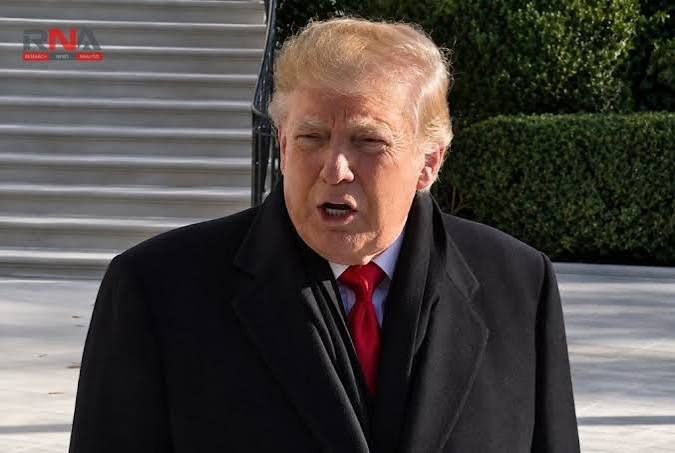
President Donald Trump has threatened major financial penalties against American technology companies that build artificial intelligence data centers outside the United States, opening a new front in Washington’s effort to keep critical computing infrastructure at home. Speaking at the White House on November 20, 2026, Trump said companies pursuing overseas projects could face a “tremendous tax,” arguing that foreign facilities could give China access to computing capacity needed to compete in artificial intelligence. The warning has immediate implications for technology companies planning international expansion, but the administration has not yet explained how the proposed penalties would work or whether any formal policy will follow.
A White House warning puts overseas data center plans under scrutiny
Trump made the remarks during a news conference after returning from his trip to Asia. He said American companies should build data centers in the United States rather than other countries, presenting domestic infrastructure investment as essential to maintaining America’s lead in artificial intelligence.
“We’re not going to allow our companies to build data centers outside of our country,” Trump told reporters. He later said firms that proceeded with overseas construction would face a “tremendous tax” and “tremendous penalties.” He also referred to a proposed project in Finland, suggesting that overseas expansion was already on the administration’s radar.
The comments were striking not only because of their potential economic impact, but also because Trump indicated that he had not yet discussed the proposal with his own officials. He did not identify a specific tax rate, legal authority, enforcement process or implementation date. As of November 21, the remarks should therefore be treated as a presidential threat rather than a new law or an established restriction on overseas construction.
Why data centers have become a strategic priority
Data centers are the physical foundation of modern cloud computing and artificial intelligence. Behind the familiar apps, online services and AI assistants are vast buildings filled with servers, networking equipment and cooling systems. These facilities process and store information, train AI models and provide the computing power businesses use to deliver digital services.
Their importance has increased as companies compete to develop more capable AI systems. Training and operating advanced models can require enormous amounts of computing capacity, making access to powerful chips and reliable electricity a strategic business concern. Governments increasingly view this infrastructure as part of national economic strength and technological security.
Trump’s argument is that keeping more data center investment inside the United States will help protect America’s lead over China. He has repeatedly presented AI competition as a national priority, and his latest comments suggest that the administration may seek to influence not only where advanced chips are sold, but also where American companies build the facilities that use them.
However, the relationship between a data center’s location and China’s access to computing power is more complicated than the president’s remarks suggest. A facility built overseas by an American company does not automatically give China access to its servers. Ownership, customers, chip specifications, access controls and the laws governing the facility all affect who can use its computing capacity.
New chip restrictions provide important context
The warning comes alongside a separate US effort to control access to advanced computing technology. On November 19, the Commerce Department’s Bureau of Industry and Security brought into effect an interim final rule addressing remote access to advanced semiconductors. The measure targets certain arrangements through which overseas data centers could provide significant computing capacity to companies headquartered in countries of concern.
The distinction between the two developments is important. The Commerce Department rule concerns exports, transfers and remote access involving specified advanced semiconductors and computing capabilities. Trump’s November 20 remarks concern the location of data center construction by American companies and the possibility of financial penalties for building abroad. The new export control rule does not, by itself, establish a general prohibition on US companies constructing data centers in other countries.
The administration’s concern is that restrictions on direct chip sales could be weakened if companies in restricted markets obtain access to advanced computing power through facilities located in third countries. Remote access can allow customers to use powerful servers without physically possessing the chips. That possibility has made international data center operations part of a much wider debate over technology exports and national security.
The official Bureau of Industry and Security publishes information about export controls and the rules governing sensitive American technology. Companies with international computing operations will need to pay close attention to the precise scope of those requirements rather than assume that every overseas facility is treated in the same way.
Technology companies could face difficult business decisions
For major cloud providers and data center operators, the location of a facility is a commercial decision as well as a political one. Companies often build infrastructure near the customers who use it. Shorter distances can reduce delays when people access cloud applications, process payments, stream content or use AI services that require quick responses.
International facilities can also help companies comply with local data protection requirements, serve regional customers and reduce the risks associated with relying on a single national power grid. Governments and businesses in Europe and Asia may prefer data to be stored and processed within their own jurisdictions, particularly when sensitive public services or commercial information are involved.
Reuters identified major US data center developers such as Equinix and Digital Realty as companies with international operations that could face questions about the direction of future investment. Cloud and technology businesses with overseas infrastructure plans may also need to assess whether a possible US penalty could change the economics of projects that were designed to serve customers abroad.
A tax or penalty could affect decisions about financing, construction schedules, partnerships and long term contracts. A company considering a facility in Finland, for example, might have to weigh the potential cost of a US government penalty against the benefits of serving European customers locally. If the rules were broad, businesses could face uncertainty even when their projects were not intended to provide computing capacity to China.
Yet the details matter enormously. A narrowly designed measure focused on national security risks would have a different effect from a broad tax on all overseas construction by American companies. Until the administration identifies the legal authority, scope and enforcement mechanism, businesses cannot calculate the actual financial exposure.
Keeping data centers in America brings its own challenges
Trump has urged American communities to welcome data center projects and negotiate benefits from developers rather than reject construction. His argument is that investment should bring jobs, local revenue and economic opportunities to the places that host the facilities.
But domestic construction is facing growing resistance. Data centers can consume enormous amounts of electricity, require substantial water resources for some cooling systems and place new demands on roads and utility infrastructure. Residents in areas experiencing rapid development have raised concerns about higher electricity bills, noise, land use and whether promised local benefits will match the scale of the projects.
These concerns have become politically significant. Recent reporting by Reuters has described disputes over how the costs of expanding electricity networks should be divided between large data center operators and ordinary households. In some regions, regulators and lawmakers are examining whether major power users should pay a larger share of the infrastructure built to serve them.
That creates a difficult balance for policymakers. The United States wants more computing capacity to support AI development, but communities also expect reliable electricity, affordable household bills and meaningful consultation before large industrial projects are approved. Encouraging domestic construction without addressing those concerns could deepen public opposition and delay the very projects the administration wants to attract.
International partners may question the wider consequences
A policy discouraging American companies from building abroad could also affect the United States’ relationships with allies. Countries in Europe and Asia are investing in their own digital infrastructure and may depend on American technology providers to supply cloud services and advanced computing capacity.
If US companies face substantial penalties for constructing facilities overseas, international customers could reconsider their dependence on American providers. Some governments may encourage domestic or regional alternatives, while companies could look for different ownership structures or partnerships to reduce their exposure to US policy changes.
The potential consequences would extend beyond the data center industry. Construction firms, equipment manufacturers, energy suppliers, chip companies and regional technology businesses all participate in the global infrastructure market. Uncertainty over where American companies can invest could influence contracts and capital spending across that supply chain.
There is also a distinction between restricting access to sensitive computing technology and restricting the location of infrastructure itself. The first approach can be targeted at specific chips, customers and security risks. The second could affect a much wider range of commercial activity, including projects serving customers in countries that are close US partners.
What happens next for American technology companies?
The most immediate question is whether the White House turns Trump’s comments into a formal policy. That would require greater clarity about which companies are covered, what counts as building a data center abroad, whether existing projects are affected and how any penalties would be calculated. The administration would also need to explain the legal authority for imposing such costs.
Technology companies and investors will be watching for statements from the White House, the Commerce Department and other relevant agencies. They will also be looking for signs that the proposal could become part of broader trade, tax or national security measures. Until formal details emerge, businesses should distinguish the president’s public warning from regulations that are already in force.
For companies reviewing international projects, several issues deserve particular attention:
- Whether overseas facilities use advanced American chips covered by existing export controls.
- Who owns, operates and receives computing services from each facility.
- Whether local data protection laws or customer requirements make regional infrastructure necessary.
- How potential US penalties could affect project financing, contracts and expected returns.
- Whether new government rules would apply to projects already under construction or only to future investments.
A new test for America’s AI infrastructure strategy
Trump’s warning highlights a central tension in the global AI race. The United States wants to maintain technological leadership, protect sensitive computing capabilities and attract investment to domestic facilities. At the same time, American technology companies operate in a global market where customers expect fast, reliable services close to where they live and work.
Keeping more infrastructure at home could support domestic investment, but a broad restriction on overseas construction could create costs for companies and customers while complicating relationships with international partners. Meanwhile, the domestic expansion that the administration favors must contend with electricity demand, local opposition and questions about who ultimately pays for new infrastructure.
For now, the proposed penalties remain undefined. The significance of the November 20 announcement lies in the direction it signals: Washington is increasingly treating the location and use of AI computing infrastructure as matters of national strategy. Whether that approach becomes an enforceable policy, and how far it reaches, will determine whether American technology companies change their global expansion plans or continue building where their customers and infrastructure needs take them.