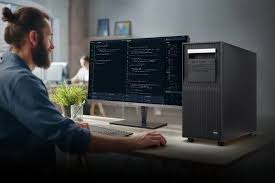
On June 15, 2026, ASUS introduced the ExpertCenter Pro ET900N, a deskside AI supercomputer built around NVIDIAs GB300 Grace Blackwell Ultra Desktop Superchip. The announcement promises data center class performance in a system small enough for a lab bench or an engineer desk. For researchers, developers, and small research teams who have wrestled with cloud costs and latency, the ET900N represents a concrete option to run large language models, generative workflows, and complex simulations locally.
What the ET900N brings to a developer workstation
The ET900N is not a scaled up workstation dressed in new marketing copy. Its architecture centers on the GB300 Grace Blackwell Ultra Desktop Superchip, which combines high bandwidth memory, advanced sparsity support, and a CPU memory coherent fabric designed to accelerate training and inference workloads that previously required racks of GPUs. ASUS pairs the chip with dense NVMe storage, high capacity DDR memory, and a chassis designed for sustained thermal performance. The result is a machine that aims to run data center class model training, fine tuning, and multimodal inference at desk level power and noise envelopes that are acceptable for lab and office environments.
Performance and workflow implications
For practitioners, the most tangible gains are lower latency for iterative experiments and predictable throughput when working with large parameter models. Developers doing prompt engineering, dataset curation, and hyperparameter sweeps can iterate faster because data movement between storage and compute is minimized. Researchers running multi GPU style distributed training on a single superchip can maintain larger effective batch sizes without incurring massive cloud egress fees or waiting in shared cluster queues. Agencies and studios that handle sensitive data will find carrying the workload on premise reduces compliance friction.
Design choices that matter for real work
ASUS focused on a few practical design elements that separate the ET900N from high end desktop builds. First, the chassis includes an active cooling strategy tuned for consistent thermal headroom rather than occasional peak bursts. That sustains throughput during long training runs. Second, serviceability and modularity allow teams to expand storage and memory without complex disassembly. Third, enterprise level firmware and remote management features make the machine manageable for IT teams responsible for a small fleet of deskside supercomputers.
Noise, power, and physical footprint
Many teams that considered on premise AI hardware have rejected it because of noise and power demands. ASUS rates the ET900N for office friendly acoustics during typical workloads and quotes a power envelope engineered to fit into dedicated labs or offices without expensive electrical upgrades. The physical footprint remains larger than a laptop and smaller than a server rack, placing it squarely in the category of deskside server that can sit under a desk or next to a workstation.
Software, ecosystem, and developer experience
Hardware without software is inert for researchers. ASUS ships the ET900N with a software stack that supports common deep learning frameworks and interoperability with containerized workflows. The presence of the GB300 chip means optimizations for model compilation, sparsity aware kernels, and memory management are available through NVIDIAs software toolchain. This ecosystem support reduces the integration burden for teams that need to move from prototype to production research quickly.
Data security and compliance
Running workloads locally changes the security calculus. Teams can keep raw training data inside institutional networks, reducing exposure to third party cloud storage providers. That can simplify compliance for regulated sectors such as healthcare, finance, and government research. ASUS complements hardware security with firmware based protections and remote management controls that integrate with enterprise authentication systems.
How the ET900N compares with cloud alternatives
Cloud providers continue to offer flexible scaling and pay as you go metering that suits ephemeral workloads. The ET900N targets a different cost profile where predictable, heavy usage over months or years favors capital expenditure. Total cost of ownership calculations will depend on utilization, electricity costs, and the value placed on latency and data control. For teams with steady, intensive compute needs and strict data governance, owning deskside compute can be more efficient than renting equivalent hours in the cloud.
When owning makes sense
- Frequent iterative development for large models where latency costs slow research velocity
- Sensitive datasets that require on premise processing for compliance
- Organizations seeking predictable monthly operating costs rather than variable cloud bills
- Creative studios or labs that need guaranteed access without queue wait times
Industry implications and signal value
The launch of a commercial deskside supercomputer signals that the compute curve is pushing capability down to smaller form factors. That matters for innovation because it decentralizes access to powerful models. Rather than concentrating experimentation in a few cloud providers, more teams can prototype and iterate locally, which may speed research cycles and diversify the types of projects attempted. It also invites institutions with limited cloud budgets to establish their own internal compute capacity.
Risks and practical limits
The ET900N is not a universal replacement for data centers. For very large scale training runs or workloads that require elastic scaling across hundreds of devices, racks and clusters remain necessary. The deskside form factor favors mid sized models, transfer learning, and inference centric production. Additionally, responsible procurement requires considering lifecycle costs such as electricity, cooling, maintenance, and eventual hardware refresh cycles. Buyers must plan for integration with backup, power protection, and secure disposal of storage media.
Expert reactions and early testing notes
Early feedback from systems engineers highlights the convenience of having a powerful, persistent compute node physically nearby. Testers report noticeably faster iteration times when tuning models locally and praise the predictable performance sustained by the thermal design. Some engineers flagged the need for clearer pricing on long term support and replacement warranties for mission critical use. Objective benchmark comparisons with cloud instances will emerge in coming months as independent labs publish throughput and energy efficiency tests.
Where to learn more and next steps
Developers and research managers evaluating on premise options should review NVIDIAs documentation on the GB300 Grace Blackwell Ultra Desktop Superchip and consult independent benchmark analyses to compare throughput and energy consumption. ASUSs official product pages provide configuration options and enterprise support details for the ET900N. For those planning deployment, pilot projects with a small number of units are the recommended path to validate workflows and calculate total cost of ownership before broader roll out.
Conclusion
The ExpertCenter Pro ET900N brings an important capability to the desk of the modern researcher and developer by concentrating data center class AI compute into a manageable, serviceable system. It will not replace large scale clusters, but it changes the calculus for teams that prize low latency, data locality, and predictable access. How broadly deskside supercomputers are adopted will depend on pricing, real world performance, and whether organizations accept the trade offs of ownership versus cloud flexibility.
NVIDIAs technical resources and ASUSs official ET900N information are useful starting points for teams considering this class of hardware