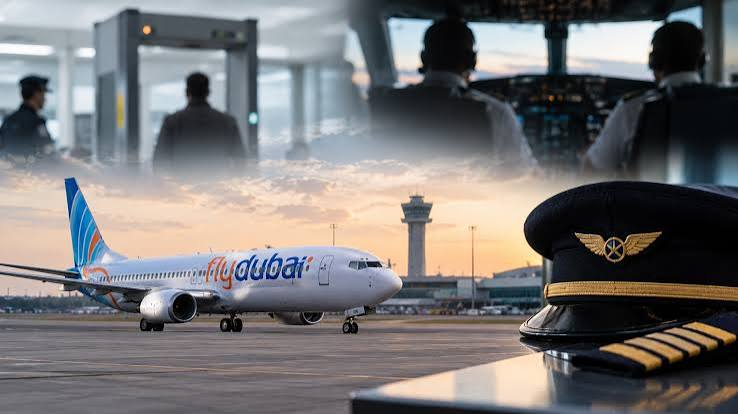
A terrifying cockpit emergency aboard a flydubai flight has forced aviation authorities, airlines and security specialists to confront a difficult question: how can commercial aviation protect passengers when the threat may come from inside the flight deck itself? The September 30 incident involving flight FZ1073, which was traveling from Dubai to Tel Aviv, ended with a safe emergency landing in Saudi Arabia, but the events in the cockpit have opened a much wider discussion about pilot screening, mental health assessments, insider threats and emergency access procedures.
What Happened Aboard Flydubai Flight FZ1073
Flight FZ1073 was carrying more than 170 people when a serious confrontation developed inside the cockpit while the Boeing 737 was cruising at high altitude. The aircraft experienced a rapid descent and sharp changes in altitude before transmitting emergency signals. The UAE General Civil Aviation Authority described the event as a security incident, while flydubai confirmed that an altercation had taken place in the flight deck.
Investigators are examining allegations that the first officer attacked the captain during the flight. The captain, Indian national Smit Machchhar, suffered injuries but managed to open the cockpit door while the aircraft was descending. Passengers and other flydubai crew members then intervened, restrained the alleged attacker and helped secure the aircraft.
The aircraft diverted to Tabuk in northwestern Saudi Arabia, where it landed safely. Both pilots were taken for medical treatment. Saudi and UAE authorities have been investigating the circumstances surrounding the incident, while questions about the motive and background of the alleged attacker remain under examination. Reuters reported that authorities were trying to establish what motivated the attack and whether it was connected to a wider security threat.
A Captain’s Actions Became Critical to the Outcome
The human element of the incident is difficult to overlook. Machchhar later described how he realized that the aircraft was descending while he was injured inside the cockpit. Speaking with Indian Prime Minister Narendra Modi from an Abu Dhabi hospital, he said he was fighting for his life while also recognizing that passengers could die if he could not regain control of the situation.
His decision to open the cockpit door created an opportunity for other people on board to intervene. That moment illustrates something aviation safety professionals have long understood: technology and procedures are only part of an emergency response. Human judgment, training and the ability to act under extreme pressure can determine whether an emergency becomes a catastrophe or a survivable event.
The incident also demonstrated the value of having additional qualified crew members aboard. Reports said off duty flydubai pilots were traveling on the aircraft and were able to help take control after the confrontation was brought under control. The aircraft ultimately reached Tabuk safely, despite the severe disruption inside the flight deck.
Why Pilot Vetting Is Now Receiving Fresh Attention
Commercial pilots already undergo extensive screening before they are allowed to operate passenger aircraft. Depending on the jurisdiction, that process can include identity verification, employment history, security checks, professional licensing requirements, medical examinations and psychological or psychiatric assessments where relevant.
Yet the flydubai incident highlights a fundamental limitation of any screening system. A medical examination or background check provides information about a person at a particular point in time. It cannot perfectly predict how someone will behave months or years later, particularly when circumstances, personal pressures or beliefs change.
Aviation analyst Saj Ahmad told Al Jazeera that pilot vetting is extensive but represents a snapshot in time. That distinction is central to the current discussion. The question facing regulators is not simply whether existing checks are thorough enough. It is whether airlines and aviation authorities should develop better ways of identifying significant changes in a pilot’s circumstances during an active career.
Mental Health Screening Is a Difficult Safety Question
The discussion around mental health requires particular care. Aviation depends on pilots being physically and psychologically capable of handling demanding situations, but stronger screening does not automatically mean better safety if it discourages pilots from seeking help.
Pilots work in an environment where fatigue, responsibility, irregular schedules and high levels of professional pressure can affect wellbeing. A system that treats every mental health concern as evidence that someone is unfit to fly could create an unintended problem by encouraging people to hide symptoms rather than report them.
For that reason, any review following the flydubai incident is likely to involve a difficult balance between security and medical privacy. Regulators and airlines must consider how to identify serious risks while maintaining systems in which pilots can seek professional support without automatically fearing the end of their careers.
The Cockpit Security Problem Has Changed
Modern cockpit security was largely designed around a different threat. After the September 11 attacks, reinforced cockpit doors and strict access procedures became central features of commercial aviation security. The goal was clear: prevent unauthorized people from reaching the flight deck.
The flydubai incident raises the opposite scenario. What happens when the person creating the danger is already inside the cockpit?
This is not a completely new aviation concern. The 2015 Germanwings disaster, in which a first officer deliberately crashed an aircraft after locking the captain out of the cockpit, generated extensive discussion about pilot mental health, cockpit access and procedures requiring more than one person to remain in the flight deck. The latest incident has revived many of those questions under dramatically different circumstances.
As aviation security specialists review the flydubai case, they will have to consider whether existing cockpit access rules provide enough flexibility for an emergency involving a member of the flight crew. A cockpit must remain extremely secure against external intrusion, but it must also allow an effective response if a serious threat develops inside.
Why the Incident Could Influence International Aviation Policy
The investigation is still developing, so it would be premature to say that aviation authorities worldwide have already adopted new pilot vetting rules because of the incident. What is clear is that the case has generated renewed scrutiny of aviation security practices across borders.
The flight involved the United Arab Emirates, Saudi Arabia and Israel, while the pilots and passengers came from different national backgrounds. That international dimension makes the case particularly relevant to regulators responsible for flights crossing several jurisdictions.
Authorities may examine several areas as investigations progress:
- How airlines conduct initial security and background checks on flight crew
- How frequently pilot medical and psychological assessments should be reviewed
- How airlines identify serious changes in a pilot’s circumstances during employment
- How cockpit access procedures work when a threat originates inside the flight deck
- How airlines coordinate with security agencies when international routes create additional screening concerns
The Federal Aviation Administration provides extensive guidance and regulatory information on aviation safety and security, while international aviation standards are developed through cooperation among national aviation authorities and global organizations.
Insider Threats Are Harder to Detect Than External Threats
One of the most difficult lessons from the incident is that aviation security cannot focus entirely on people trying to enter restricted areas. The people who already have authorized access can present a fundamentally different security challenge.
Airline employees need access to sensitive systems, restricted facilities and aircraft because their jobs require it. Pilots in particular have extraordinary operational authority once an aircraft leaves the ground. That authority is necessary for safe aviation, but it also means that employee security assessments have consequences far beyond a normal workplace background check.
The challenge is creating a system that identifies credible warning signs without turning ordinary employees into security suspects. Airlines will need to consider how information is shared between human resources departments, medical professionals, security teams and aviation regulators while respecting legal protections and confidentiality.
Passengers Also Saw the Importance of Human Response
For the people aboard FZ1073, the experience was far removed from the technical language of aviation regulation. A sudden descent, unfamiliar movement and confusion inside the cabin can produce intense fear within seconds.
Passengers and crew members nevertheless responded when they understood that something was seriously wrong. Their intervention helped prevent the situation from escalating while the injured captain worked to make the cockpit accessible.
That response reinforces another important part of aviation safety: emergency preparation extends beyond the pilots. Cabin crew training, communication procedures and clear coordination between flight deck and cabin personnel can become critical when an abnormal situation develops.
What Airlines May Review Next
The most useful response to the flydubai emergency will not necessarily be a single new rule. Aviation safety generally improves through layers of protection. When one layer fails, another should reduce the chance of disaster.
Airlines may therefore examine whether their current systems provide sufficient protection at several stages, from recruitment and background screening to continuing medical oversight, crew reporting systems, cockpit procedures and emergency response training.
The industry may also revisit how pilots can confidentially report personal difficulties and receive professional assistance. A safety system that encourages early reporting could potentially identify problems before they become operational risks, while avoiding a culture in which pilots feel compelled to conceal difficulties.
Aviation Security Faces a More Complicated Future
The flydubai incident is still under investigation, and the final findings will matter greatly before regulators decide whether any formal changes are necessary. Questions about the alleged attacker’s motive, background and circumstances must be answered through evidence rather than speculation.
What the incident has already demonstrated is that aviation security is not a finished system. Reinforced cockpit doors solved one category of threat, but they cannot solve every possible danger. Passenger screening protects against unauthorized access, but it does not address every insider risk. Medical examinations can identify important concerns, but they cannot predict every future action.
We should therefore view the FZ1073 investigation as part of a broader safety conversation rather than as proof that existing aviation systems have failed. Commercial aviation has developed some of the world’s most sophisticated safety procedures precisely because previous emergencies revealed weaknesses that could be addressed.
For passengers, the most reassuring fact from this frightening episode is that several layers of human response ultimately worked together. An injured captain continued fighting to protect those aboard. Cabin occupants responded when the danger became visible. Additional qualified crew members helped regain control, and authorities on the ground prepared for the emergency landing.
The next stage belongs to investigators and regulators. Their task is to determine exactly what happened, why it happened and whether existing safeguards should change. If the aviation industry takes those findings seriously, the legacy of this frightening flight could be a stronger approach to pilot wellbeing, insider threat detection and cockpit emergency procedures without compromising the trust and privacy that professional aviation also requires.