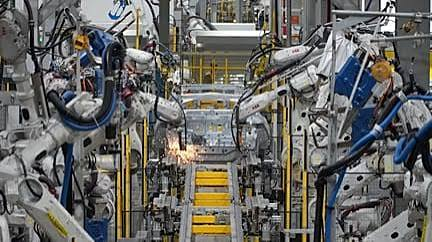
More than 5 million industrial robots are now operating inside factories around the world, marking a major milestone for manufacturing automation and signaling how quickly intelligent machines are becoming part of ordinary industrial production. New figures from the International Federation of Robotics show that the global operational stock reached 5.079 million units in 2025, after factories installed a record 603,000 new industrial robots during the year. The milestone arrives as artificial intelligence, machine vision, improved sensors and easier programming expand the range of tasks robots can perform.
Five Million Robots Now Form Part of the Global Manufacturing Base
The latest figures represent a substantial change in the scale of industrial automation. The International Federation of Robotics reported that the global operational stock of industrial robots increased 9 percent in 2025. Annual installations rose 11 percent to 603,000 units, marking the first time worldwide installations exceeded 600,000 in a single year.
For people outside manufacturing, 5 million machines can be difficult to picture. Inside factories, however, these robots are not simply futuristic machines standing apart from human workers. They are increasingly integrated into production lines where they handle repetitive, precise or physically demanding tasks.
A robotic arm may move components between stations, weld vehicle bodies, place electronic parts, load machinery or perform inspections using cameras and sensors. In another factory, automated equipment may work beside employees who remain responsible for quality checks, programming, maintenance and decisions about production.
The scale of the change becomes clearer when viewed over time. The current operational stock is more than twice the level recorded seven years earlier, according to the robotics federation. The growth reflects years of investment in factory automation rather than a sudden single year shift.
AI Is Changing What Industrial Robots Can Do
Traditional industrial robots have often been associated with highly repetitive movements carried out in controlled environments. Modern systems are becoming more adaptable because artificial intelligence can help machines interpret visual information, recognize objects, adjust movements and respond to changes in production conditions.
Machine vision is particularly significant. Cameras and software can allow a robot to identify components, inspect surfaces and detect differences that would be difficult to manage through fixed mechanical instructions alone. Improved sensing technologies can also help machines respond more accurately to their surroundings.
The International Federation of Robotics identifies artificial intelligence, machine vision and sensing as important developments supporting the expansion of industrial robotics. Easier programming and system integration are also reducing some of the barriers that previously made automation difficult for smaller manufacturers.
That does not mean every industrial robot has suddenly become an independent decision maker. Most factory robots still operate within carefully designed systems with defined tasks, safety controls and human oversight. The significance of AI is that it can make those systems more capable and flexible.
China Remains the Largest Source of New Robot Installations
Asia continues to dominate global industrial robot adoption, with China accounting for the largest share of new installations. The latest figures show that China installed 354,000 industrial robots in 2025, an increase of 20 percent from the previous year. Chinese installations represented 59 percent of global deployments during the year.
The country’s domestic robotics industry is also becoming more significant. Chinese manufacturers supplied 195,000 robots to their home market in 2025, giving domestic suppliers a 55 percent share of installations there.
That combination of large manufacturing capacity, substantial automation investment and expanding domestic robotics production has made China a central market for industrial automation. The country’s position also affects global suppliers because the scale of Chinese demand influences technology development, manufacturing capacity and competition across the robotics industry.
The United States Records Strong Growth
The United States also recorded substantial growth in industrial robot installations during 2025. Installations increased 12 percent to almost 38,500 units, according to the International Federation of Robotics.
The growth reflects continued investment in automation across American manufacturing. Automotive production remains an important customer, but demand is also developing in food production and other industries outside traditional vehicle manufacturing.
Automation can be particularly attractive to manufacturers dealing with labor shortages, difficult working conditions or pressure to maintain consistent production. A robot can repeatedly perform the same physical movement without fatigue, while workers can focus on tasks that require judgment, supervision, troubleshooting or specialized knowledge.
The effect on workers is more complicated than a simple replacement story. Some roles can be reduced or redesigned when a production process becomes automated, while other positions emerge around robot programming, maintenance, engineering, integration and data analysis. The transition therefore changes the skills required inside a factory as much as it changes the machines on the production floor.
Europe Is Moving More Slowly
Europe remains a major robotics region, although recent growth has been more moderate than in some Asian and American markets. Germany continues to be Europe’s largest industrial robot market and accounted for 41 percent of total installations within the European Union in 2025.
Germany installed fewer than 25,000 robots during the year, representing an 8 percent decline. Italy also recorded a decline, while France and Spain saw their installations fall as well.
These differences show that the global robotics story is not uniform. Economic conditions, industrial structures, energy costs, investment cycles and the strength of individual manufacturing sectors can all affect how quickly companies purchase new automation equipment.
Automotive and Electronics Remain Major Users
The automotive industry has historically been one of the largest users of industrial robots, and it remains central to the market. Vehicle manufacturing requires highly repeatable operations such as welding, painting, component handling and assembly, making it well suited to industrial automation.
Electronics manufacturing is another important area. Components can be extremely small and production volumes can be enormous, creating demand for machines capable of precise and repeatable handling.
The latest robotics data show that installations in both automotive and electronics increased 10 percent in 2025. Metal and machinery applications grew even faster, with installations rising 22 percent.
That wider industrial adoption matters because it suggests robotics is no longer confined to a narrow group of highly automated factories. As technology becomes easier to integrate, more manufacturers can consider automation for individual production stages rather than rebuilding an entire facility around robots.
Labor Shortages Are Helping Drive Investment
One of the strongest forces behind industrial automation is the changing availability of workers. Many manufacturing economies face aging populations, labor shortages or difficulty recruiting people for repetitive and physically demanding jobs.
Automation can help manufacturers maintain output when they cannot easily expand their workforce. A robot does not eliminate the need for employees, but it can change how human labor is used. Workers may supervise several automated stations, perform maintenance, handle exceptions or move into higher skill positions.
The International Federation of Robotics expects these demographic pressures to remain a structural driver of robot adoption. The organization also points to efforts by companies to build manufacturing capacity closer to customers and in higher wage economies as another factor supporting demand.
Factories Are Becoming More Connected
The growth of industrial robotics is also connected to the broader development of smart manufacturing. Robots increasingly operate as part of connected production systems rather than as isolated machines.
Sensors can collect information about equipment performance. Vision systems can inspect products. Manufacturing software can track production data. Artificial intelligence can analyze information and help identify patterns that may indicate quality problems or equipment issues.
When these systems work together, the factory becomes more responsive. A production manager can gain a clearer picture of what is happening on the floor, while engineers can use data to investigate problems and improve processes.
That shift creates new responsibilities as well. Connected factories require cybersecurity protections, reliable networks, trained technicians and clear procedures for handling automated equipment. The more dependent a facility becomes on digital systems, the more important it becomes to protect those systems from technical failures and cyber threats.
What the Five Million Milestone Means for Workers
The number 5 million can sound like a story about machines, but the human consequences may ultimately be more significant. Every automated production line affects the people who design it, operate it, maintain it and work alongside it.
Workers entering manufacturing are likely to encounter more software, sensors, robotics and automated inspection systems than previous generations did. Technical education and workplace training will therefore become increasingly important.
Companies adopting robots also face a practical responsibility to prepare employees for the transition. Training workers to maintain and supervise automated equipment can help preserve valuable experience while allowing employees to move into roles created by new technology.
For consumers, the changes may be less visible. The products arriving on store shelves may look the same, but the factories producing them could operate with increasingly sophisticated combinations of people, machines, software and artificial intelligence.
The Robotics Market Is Expected to Keep Growing
The International Federation of Robotics expects global industrial robot installations to increase another 9 percent in 2026, reaching approximately 655,000 units. Its longer term outlook projects annual installations could reach 806,000 units by 2029.
Those projections reflect several forces working at the same time. Manufacturers are seeking greater productivity, companies are responding to labor shortages, supply chains are being redesigned and advances in AI are expanding the tasks that automated systems can handle.
The federation also reports that global robot demand has returned to a stronger growth trajectory after several years of relatively flat development. The five million robot milestone therefore represents not only a historical figure but also a snapshot of an industry that continues to expand.
A Manufacturing Shift That Is Becoming Hard to Ignore
Five million operational industrial robots do not mean that factories have become fully autonomous, nor do they indicate that human workers are disappearing from manufacturing. What the figure shows is that robotics has become an established part of the global industrial economy.
We are entering a period in which the most significant question may no longer be whether factories will use robots, but how effectively people and automated systems can work together. AI is giving machines better perception and flexibility, while human workers remain essential for engineering, judgment, maintenance, supervision and problem solving.
The milestone also provides a useful reminder that automation is not a single technology. It is a combination of robotics, artificial intelligence, sensors, software, industrial data and human expertise. As those elements continue to develop together, the factory floor of the coming decade may look considerably different from the one many workers know today.
For businesses, the challenge will be deciding where automation genuinely improves production and where human skills remain more valuable. For workers, the challenge will be acquiring the technical knowledge needed to operate alongside increasingly capable machines. And for the robotics industry, the five million mark represents a significant achievement, while the next phase will depend on how safely, responsibly and effectively those millions of machines are integrated into real workplaces.
The International Federation of Robotics provides continuing global statistics on industrial automation, robot installations and the changing role of robotics in manufacturing.