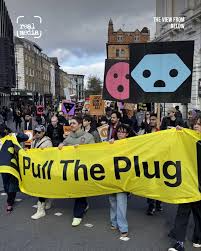
Hundreds of demonstrators took to the streets of central London on Saturday, November 21, calling on the British government to introduce stronger rules for artificial intelligence and slow the development of advanced AI systems until their risks can be better controlled. Gathering near the BBC headquarters before marching toward Downing Street, protesters carried warning signs and called for greater public oversight of technology they believe is advancing faster than governments can respond. The demonstration, organized by campaign group Pause AI UK, brought growing concerns about artificial intelligence directly to the doorstep of the Prime Minister’s Office.
Why protesters took their concerns to Downing Street
The march focused on a central question facing governments around the world: how can society benefit from increasingly capable artificial intelligence while protecting people from potential harm? For the demonstrators, existing safeguards are not sufficient to address the risks posed by the most advanced systems.
Participants gathered near the BBC’s central London offices before making their way toward Downing Street. Their placards carried direct messages, including calls not to build artificial general intelligence, warnings that AI could threaten human survival and demands that people retain control over decisions affecting their future.
The demonstration was organized by Pause AI UK, a campaign group that advocates a halt to the development of frontier AI models. These are among the most advanced artificial intelligence systems being developed, with capabilities that may extend across reasoning, coding, research and other complex tasks.
The organizers argue that development should not continue at its current pace without stronger evidence that powerful systems can be controlled and deployed safely. Their position reflects concerns that the consequences of a serious failure could extend beyond individual users or companies and affect wider society.
Pause AI UK calls for a pause in advanced AI development
Pause AI UK has made a temporary halt to the development of the most powerful AI systems a central part of its campaign. The group argues that governments should establish enforceable safeguards before companies create systems with capabilities that may be difficult to predict or manage.
Its demands go beyond general calls for responsible technology. The campaign supports legislation specifically addressing frontier AI development and a broader international agreement to pause the creation of the most powerful systems until credible safety measures are in place.
The distinction matters because artificial intelligence is not one single technology. Everyday applications such as writing assistants, translation software and image recognition tools present different challenges from highly capable systems that can perform complicated tasks with limited human supervision.
Regulation designed for ordinary software may not be sufficient for systems that can act across multiple digital environments, write and execute code, or assist with sensitive scientific and technical work. Campaigners want lawmakers to consider these differences before advanced capabilities become widely available.
What is artificial general intelligence?
One phrase appearing on placards during the London march was artificial general intelligence, commonly known as AGI. The term generally describes a hypothetical form of AI capable of performing a broad range of intellectual tasks at a level comparable to or beyond human ability.
There is no universally accepted definition of AGI, and researchers disagree about how close current systems are to achieving it. Today’s leading AI models can perform impressive tasks, including generating computer code, analyzing documents, answering complex questions and assisting with scientific research. However, they also make mistakes, produce misleading information and struggle with some forms of reliable reasoning.
For campaigners, the concern is not limited to what AI systems can do today. They are also asking what could happen if future systems become substantially more capable while remaining difficult to supervise. The possibility of systems acting in unexpected ways has become a major subject of debate among researchers, technology companies and policymakers.
Supporters of stronger safeguards argue that governments should not wait for a serious incident before establishing clear responsibilities. Critics of a complete development pause, however, question whether stopping progress is practical and warn that excessive restrictions could limit useful research and economic opportunities.
AI regulation raises questions about safety, jobs and public accountability
The debate surrounding advanced artificial intelligence extends well beyond the possibility of future superintelligent systems. People are already experiencing changes in how technology affects employment, education, privacy and access to information.
Employment and economic disruption
AI tools are increasingly being used to assist with writing, customer service, software development, administration and data analysis. These applications can help businesses complete tasks more quickly, but they also raise concerns about how work may change and whether some occupations will face significant disruption.
Workers want to know whether employers will use AI to support their jobs or replace parts of their existing responsibilities. Governments face pressure to consider training, employment protections and policies that help people adapt as businesses introduce automated systems.
Privacy and the use of personal information
Artificial intelligence systems can process large volumes of information, including personal data. Questions about how that information is collected, stored and used have become increasingly important. Poorly managed systems may expose individuals to privacy violations, unfair profiling or decisions that are difficult to challenge.
Stronger oversight could establish clearer expectations for companies handling personal information and require greater transparency when AI influences decisions involving employment, financial services, healthcare or public administration.
Security and the possibility of misuse
Advanced AI can also create security challenges. The same capabilities that help researchers, programmers and businesses may be misused to support cyberattacks, fraud or the creation of harmful material. As systems become more capable, identifying and limiting dangerous uses becomes more complicated.
These concerns help explain why campaigners are asking for rules that apply not only to how AI products are used but also to how powerful models are developed, tested and released.
The UK government faces pressure to clarify its regulatory approach
The protest comes as the United Kingdom continues to examine how existing laws and regulatory institutions should respond to increasingly capable artificial intelligence. The government has relied on existing sector regulators and specialist institutions to address many AI related risks, while maintaining that further legislation may be necessary as technology develops.
A government response published by Parliament acknowledges that current regulatory arrangements may not always be sufficient as AI capabilities advance. It says additional safeguards, legal powers or legislation could be considered where evidence shows that stronger protections are needed to protect human rights and public safety.
The response also highlights the role of the AI Security Institute, which evaluates advanced AI models to improve understanding of their capabilities, limitations and potential risks. The institute works with industry and international partners, including on assessments of models before public release. Its role is to provide evidence that can inform policy and risk management rather than certify that a model is completely safe.
This distinction is important. Testing can help identify weaknesses and provide information for regulators, but it cannot guarantee that every risk has been discovered. The challenge for policymakers is to determine what companies must do when testing reveals serious concerns and what consequences should follow if developers fail to meet their responsibilities.
The government’s full position on human rights and AI regulation is available through the UK Parliament’s published response on AI safeguards.
Why a clear regulatory framework matters
For businesses developing artificial intelligence, clear rules can establish expectations around testing, documentation, security and responsibility. Companies need to understand which risks they must assess before releasing powerful systems and what obligations apply when those systems are used in sensitive settings.
For the public, effective regulation should make it possible to question decisions influenced by AI and seek remedies when systems cause harm. People should not be left without meaningful explanations simply because a decision was made with the assistance of complex software.
Regulators also face the difficult task of keeping rules relevant as technology changes. Requirements that are too narrow may quickly become outdated, while rules that are too broad could restrict beneficial research and place unnecessary pressure on smaller developers. A credible framework must be proportionate to the risks while giving the public meaningful protection.
Saturday’s march follows earlier protests targeting major technology companies
The November demonstration was not the first time AI safety campaigners had taken their concerns to the streets of London. In February 2026, more than 300 people marched from the London office of OpenAI through the King’s Cross area toward offices associated with Google and Meta.
That earlier demonstration called on the leaders of major technology companies to publicly support a pause in the development of advanced AI. The November march shifted the focus more directly toward government responsibility, taking campaigners from the area around the BBC headquarters to the entrance of Downing Street.
The two demonstrations reflect a growing effort to bring AI governance into public debate. While discussions about advanced technology often take place among researchers, company executives and government officials, campaigners want ordinary citizens to have a stronger voice in decisions that could affect employment, privacy, security and the future of society.
Information about the campaign’s objectives and proposed actions is available through the Pause AI UK campaign website.
What happens after the London demonstration?
The march has placed another public demand for stronger AI oversight before the British government, but a protest alone does not establish new policy. The next stage depends on whether campaigners can turn public concern into sustained political pressure and whether lawmakers are willing to translate broad safety goals into enforceable requirements.
Several questions remain central to the debate. Should developers be required to obtain independent assessments before releasing the most powerful models? Should companies face legal consequences when they fail to address foreseeable risks? How should regulators distinguish between ordinary AI applications and systems with potentially dangerous advanced capabilities? And should decisions about future development involve a wider public consultation?
There are no simple answers. Artificial intelligence has the potential to support medical research, improve accessibility, assist education and help businesses solve difficult problems. Preventing those benefits from reaching society would carry its own costs. At the same time, allowing powerful systems to develop without adequate testing, transparency and accountability could create risks that are difficult to reverse.
A growing public debate over who controls the future of AI
The London march reflects a wider disagreement about the balance between technological progress and public safety. Supporters of rapid development often point to the economic and scientific opportunities that artificial intelligence could create. Campaigners calling for a pause argue that progress should depend on the ability to demonstrate that increasingly capable systems can be controlled.
For people watching the debate from outside the technology industry, the central issue is straightforward: decisions about powerful AI systems should not be left entirely to the companies building them. Governments have a responsibility to protect the public, while developers must demonstrate that their products are being created and deployed with appropriate care.
Saturday’s demonstration did not resolve that debate, nor did it produce an announced government commitment to the campaign’s demands. But by bringing hundreds of people from central London to Downing Street, Pause AI UK ensured that questions about advanced AI safety, regulation and democratic accountability remained firmly in the public conversation.
The challenge for Britain now is to develop an approach that protects people without closing the door on useful innovation. As artificial intelligence becomes more capable, the credibility of that approach will depend not on promises alone, but on transparent testing, clear legal responsibilities and safeguards that can keep pace with the technology.