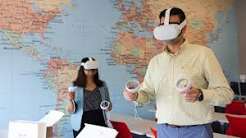
Universities across the United States and Europe are expanding academic partnerships built around immersive technology, with Meta playing a growing role in efforts to bring virtual reality and spatial computing into higher education. Announced developments on September 6, 2026, point toward a new model for remote STEM education in which students can enter interactive laboratory environments, examine three dimensional objects, conduct simulated experiments, and work with classmates even when they are separated by thousands of miles.
Universities Look Beyond Traditional Remote Learning
Remote education has traditionally depended on video lectures, digital textbooks, discussion boards, and conventional learning management systems. Those tools made it possible for students to attend classes from home, but they could not easily reproduce the physical experience of standing inside a laboratory or working beside another student at a research station.
Virtual reality introduces a different possibility. Instead of watching a laboratory demonstration on a flat screen, students can enter a simulated environment and interact with equipment, models, samples, and scientific processes. A biology student might examine a virtual cellular structure at a scale that would be difficult to experience physically. An engineering student could inspect a complex machine from multiple angles. Chemistry students could practice procedures in controlled simulations before working with real materials.
The emerging university partnerships involving Meta are built around this broader concept of immersive learning. The objective is not simply to replace classrooms with headsets. Rather, institutions are exploring how spatial computing can become another layer of academic instruction that supports collaboration, experimentation, visualization, and practical training.
Meta’s Technology Opens New Possibilities for STEM Education
Meta has invested heavily in virtual reality hardware, software, and immersive experiences through its Reality Labs division. Its Quest platform has helped bring consumer virtual reality into homes, while its software ecosystem provides developers with tools for building interactive experiences.
For universities, the attraction is the possibility of adapting those capabilities for education. A virtual campus can connect students who might otherwise never share the same physical laboratory. Faculty members can demonstrate complex concepts using three dimensional objects, while students can manipulate digital models and observe results from different perspectives.
The Meta ecosystem also gives educators access to a broader technology environment that can support virtual meetings, immersive experiences, and collaborative digital spaces. The educational value, however, depends heavily on how institutions design their courses and whether immersive technology genuinely improves learning outcomes.
Remote Laboratories Could Help Address Access Gaps
One of the strongest arguments for virtual laboratories is access. Universities cannot build unlimited physical laboratories, and expensive equipment may be available only to students enrolled at particular campuses. A well designed virtual environment could give learners an additional way to practice concepts before using scarce physical resources.
This could be especially useful for students studying engineering, medicine, physics, computer science, environmental science, and other technical disciplines. A student living far from campus could potentially participate in laboratory preparation without traveling several hours simply to attend a short practical session.
For universities working across national borders, the opportunity becomes even more significant. Students in Europe could collaborate with classmates in the United States inside the same virtual research environment. Faculty members could demonstrate specialized equipment to international groups without requiring everyone to be physically present.
Virtual Reality Does Not Replace the Physical Laboratory
There is a natural temptation to describe immersive education as a replacement for conventional classrooms and laboratories. We should be more careful. Virtual reality can reproduce many aspects of a laboratory experience, but it cannot reproduce everything.
Students working with physical materials develop sensory and practical skills that are difficult to simulate completely. The weight of equipment, the texture of materials, the smell of chemicals, the subtle resistance of a mechanical component, and the unpredictability of physical experiments all contribute to professional training.
For that reason, the most useful university programs are likely to combine virtual preparation with physical instruction. Students could first practice procedures in a simulated environment, make mistakes safely, repeat difficult tasks, and receive digital guidance. They could then enter a real laboratory with greater familiarity and confidence.
Immersive Classrooms Could Change How Students Collaborate
Another major development is the social dimension of virtual learning. Conventional online classes can make collaboration feel fragmented. Students appear as small windows on a screen, and group projects can sometimes feel like a collection of separate conversations rather than shared work.
A spatial environment can create a stronger sense of physical presence. Students can gather around a virtual model, point toward specific components, discuss findings, and move through a shared environment together. The experience may feel closer to working around a laboratory table than sitting alone behind a computer.
That difference matters because STEM education often depends on teamwork. Scientists and engineers rarely work entirely alone. They explain ideas, compare observations, challenge assumptions, and solve problems together. Immersive collaboration could give remote students more opportunities to develop those habits.
European and American Universities See a Global Opportunity
The international dimension of these partnerships is particularly significant. Higher education institutions increasingly operate through global research networks, exchange programs, joint degrees, and international faculty relationships. Virtual reality can add another channel for cooperation.
A professor in one country could conduct a specialized session for students in another without arranging international travel. Research groups could meet inside shared virtual environments to examine digital models. Universities could also develop common laboratory exercises that allow students from different academic systems to work on the same scientific problem.
Such collaboration could make education feel less constrained by geography. A student’s physical campus would remain important, but it would no longer have to define the entire boundary of the student’s academic community.
Privacy, Cost and Accessibility Remain Serious Questions
The expansion of immersive education also raises difficult questions that universities cannot ignore. Virtual reality requires hardware, software, technical support, reliable connectivity, and appropriate physical spaces. Providing headsets to every student can create substantial costs, particularly for institutions with large enrollment.
Accessibility is another concern. Not every student can comfortably use immersive hardware for extended periods, and universities must consider students with disabilities, motion sensitivity, visual limitations, or other accessibility needs. An immersive course should therefore provide alternative methods of participation rather than making a headset the only path to academic success.
Privacy deserves equal attention. Educational platforms can potentially process information about user activity, interactions, movement, communication, and engagement. Universities need clear policies covering data collection, storage, consent, security, and third party access before deploying immersive systems at scale.
The United States Department of Education provides resources and policy information that can help institutions consider broader questions surrounding technology, accessibility, and student participation in education.
Faculty Training Will Determine Whether the Technology Works
Technology alone does not create better teaching. A poorly designed virtual laboratory can become little more than an expensive digital demonstration. The success of these programs will depend on faculty members who understand both their academic subjects and the strengths and limitations of immersive learning.
Professors may need training in designing spatial lessons, managing virtual group activities, assessing student performance, and determining when an immersive experience adds genuine educational value. Universities will also need technical teams capable of maintaining equipment and assisting students who encounter hardware or software problems.
The strongest programs are likely to begin with specific educational problems rather than starting with the technology itself. If a three dimensional simulation helps students understand molecular structures more effectively, it has a clear purpose. If a virtual environment merely reproduces a lecture that works perfectly well on a conventional screen, the additional complexity may not be justified.
Students Could Gain More Opportunities for Practice
One of the most promising features of immersive education is repetition. Students often hesitate to repeat difficult laboratory procedures because physical materials, equipment time, and instructor availability are limited. A virtual environment can allow learners to practice repeatedly without consuming laboratory supplies.
A student can make an error, review what happened, reset the simulation, and try again. That process can reduce the fear associated with making mistakes while learning. By the time students enter a physical laboratory, they may already understand the sequence of actions required to complete an experiment.
For educators, virtual simulations can also provide additional ways to assess learning. Instead of relying only on written examinations, instructors may be able to observe how students approach a problem, identify equipment, follow procedures, and respond to changing conditions.
A New Layer of the University Campus
The expansion of Meta supported virtual reality partnerships does not mean that universities are preparing to abandon physical campuses. The more realistic future is a blended academic environment where physical and virtual spaces complement one another.
Students may attend lectures in person, conduct some experiments in physical laboratories, practice other procedures through virtual simulations, and meet international classmates inside shared digital spaces. The campus becomes both a physical location and a network of connected learning environments.
That model could be especially valuable for STEM education, where visualization and practical experience are central to learning. It may also give universities new ways to connect specialized expertise with students who would otherwise have limited access to it.
The Next Test Is Educational Value
The excitement surrounding virtual reality in higher education is understandable, but the next stage will require evidence. Universities will need to determine whether students learn more effectively, retain information longer, collaborate better, and develop stronger practical skills through immersive instruction.
Those answers will matter more than headset specifications or the novelty of entering a virtual campus. Students and families ultimately want education that produces knowledge, confidence, professional skills, and meaningful opportunities.
For now, the growing partnerships between Meta and higher education institutions signal an important experiment in the future of remote learning. The most compelling possibility is not a campus without classrooms. It is a campus with more ways to teach, practice, collaborate, and explore. If universities can combine immersive technology with strong faculty instruction, accessible design, responsible data practices, and meaningful physical training, virtual reality could become a practical part of the modern academic experience rather than simply another piece of educational technology.