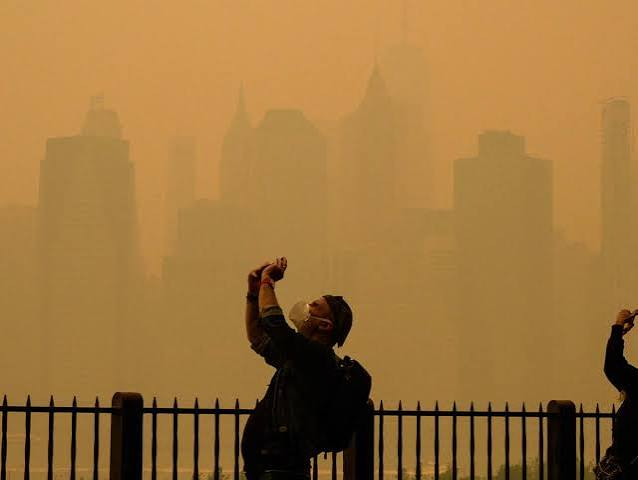
Heavy smoke from Canadian and American wildfires is spreading far beyond the burn zones, sending air quality warnings across multiple states and forcing more than 100 million people to rethink how they move, work, train, and gather. What began as a fire season has become a daily public health and lifestyle disruption, with hazy skies, throat irritation, and reduced visibility now shaping ordinary decisions from morning runs to evening fashion events.
A haze that travels
Smoke does not respect borders, and this week that reality is impossible to ignore. Winds have carried fine particulate pollution from active fires in Canada and the United States into densely populated areas, coating skylines in a pale gray veil and pushing air quality into unhealthy ranges in parts of the country. The result is not just a change in the weather. It is a change in how people live, breathe, and plan their day.
For families, the first signs are often small but unmistakable. Eyes sting on the commute. The air smells like a distant campfire. Children ask why the sky looks wrong. Adults check outdoor alerts before deciding whether to jog, garden, walk the dog, or simply keep the windows shut. The cumulative effect is exhausting, especially when smoke lingers for days and the relief of a clear morning never quite arrives.
Public health warnings rise
State and local agencies have responded with widespread air quality warnings, urging residents to limit prolonged outdoor activity, especially in affected corridors where smoke is thickest. Those cautions are most urgent for older adults, young children, pregnant people, and anyone living with asthma, heart disease, or other respiratory conditions. Fine smoke particles can penetrate deep into the lungs and worsen symptoms even when the haze looks thin enough to ignore.
We often talk about pollution as if it were a distant statistic, but wildfire smoke makes it immediate. A person may feel fine in the morning and struggle by afternoon after a few hours outside. That shift can happen quickly when outdoor air is loaded with particulate matter. The advice from public health authorities remains straightforward: reduce exposure where possible, use indoor filtration if available, and treat worsening breathing symptoms as a serious warning sign.
Fitness routines go indoors
One of the clearest lifestyle changes is playing out in parks, gyms, and neighborhood streets. Outdoor fitness has been sharply disrupted as runners, cyclists, and casual walkers decide whether to push through the haze or stay inside. For many people, exercise is part of emotional balance as much as physical health, so the disruption feels personal. A morning run once associated with fresh air now carries the opposite meaning.
Fitness trainers and studio operators are adapting quickly. Classes are moving indoors, workout schedules are shifting, and some communities are seeing a burst of demand for treadmills, stationary bikes, and home exercise alternatives. Yet not everyone has access to a safe indoor space, which makes the smoke more than an inconvenience. It becomes a barrier to routine, especially for people who rely on public parks or neighborhood sidewalks as their primary place to stay active.
Common smoke day adjustments
- Switch outdoor runs to indoor cardio or strength sessions.
- Shorten time spent outside and avoid peak smoke periods.
- Run air cleaners at home if they are available.
- Keep windows closed unless local guidance says otherwise.
Events feel the pressure
The smoke is also reshaping cultural and social calendars. Outdoor fashion events, product launches, rooftop gatherings, and open air performances are being reconsidered or scaled back because visibility, comfort, and health conditions have all become uncertain. In cities where summer schedules are built around street life and outdoor spectacle, the haze creates a quiet but powerful sense of interruption.
Event organizers face difficult choices. Move indoors and risk smaller capacity. Proceed outside and risk complaints, discomfort, or worse. Delay and disappoint guests. The smoke does not just affect aesthetics, though it certainly blurs the visual drama of a runway show or a rooftop reception. It alters attendance, staffing, sound conditions, photography, and the basic sense of ease that events depend on.
Fashion, in particular, relies on atmosphere. Designers count on light, movement, and a controlled environment to make clothes feel aspirational. When smoke dulls the sun and hangs in the air like a curtain, it changes the mood instantly. Guests arrive more guarded, staff spend more time worrying about indoor air, and the entire experience becomes more about survival than style.
Daily choices become health choices
The deeper impact of wildfire smoke is that ordinary lifestyle decisions begin to carry health weight. People choose the grocery run over the park walk. Parents keep children home from outdoor play. Commuters consider masks, car air filters, and alternate routes. Even simple errands feel more deliberate when the air outside is visibly unhealthy.
For many households, the smoke is also a financial issue. Air purifiers, upgraded filters, and sealed windows are not equally accessible. People in older housing or crowded apartments may have fewer options for reducing exposure indoors. That inequality matters because wildfire smoke tends to spread broadly but burden unevenly. Those with the least flexibility often suffer the longest.
We should also be honest about the emotional strain. A gray sky can be unsettling in a way that is hard to explain until you live under it. It flattens the day, makes distances look smaller, and creates the odd sensation that the world has been muted. For children, that can be confusing. For adults already stretched thin, it can feel like one more layer of stress on top of an already difficult summer.
What people can do
Public guidance during smoke events is simple, but it only works when people can act on it. Staying indoors with windows closed can help reduce exposure. So can using high quality air filters and avoiding strenuous outdoor activity when air quality is poor. Those who must work outside, especially in delivery, construction, landscaping, or event production, may need extra breaks, better masks, and more monitoring of symptoms.
Families should pay close attention to changes in breathing, chest tightness, unusual fatigue, or worsening cough. These are not signs to ignore, especially for people with existing respiratory conditions. Local health departments and air quality agencies are the best sources for near real time guidance, since smoke conditions can change from hour to hour depending on wind and fire behavior.
The bigger climate pattern
This moment is about more than one smoky week. It is part of a broader pattern in which wildfire seasons are becoming more disruptive, more expansive, and harder for cities to absorb. The smoke now crossing state lines is a reminder that fire is no longer just a regional event. It is a national lifestyle issue, a public health issue, and a planning issue for schools, workplaces, venues, and families.
That reality demands both immediate caution and longer term thinking. Communities will need better building filtration, clearer public alerts, and more flexible event planning if they want to reduce harm in future smoke seasons. Employers may need to rethink outdoor work schedules. Cities may need to treat smoke days with the same seriousness they give to storms or extreme heat. The old assumption that summer means open windows and long evenings outside no longer holds everywhere, every year.
For readers seeking reliable air quality and health updates, the AirNow network remains a key public resource, while the CDC wildfire guidance provides practical health advice for smoke exposure and respiratory protection.
A season of caution
For now, the most useful response is patience paired with preparation. Smoke events may come and go, but the effects on routine life are real while they last. People are not just changing their plans. They are changing the way they think about air itself. That is a profound shift, and one that many communities will continue to confront as wildfire seasons grow more volatile.