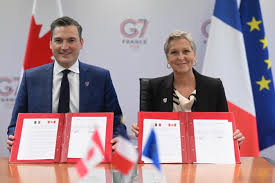
Canada and France signed a landmark bilateral treaty on May 29, 2026 at the G7 Digital Ministers meeting committing to co develop, fund, and secure multidisciplinary quantum computing and artificial intelligence capabilities. The agreement seeks to accelerate basic research, speed technology transfer to industry, and build joint safeguards that reduce strategic risks as quantum and AI systems move from laboratory curiosities into tools with broad economic and security implications.
What the treaty covers and why ministers acted now
The pact creates joint funding instruments for quantum hardware and software research, establishes shared road maps for scalable qubit systems, and formalises cooperation on post quantum cryptography and AI model robustness. Officials described the treaty as both a competitive and defensive measure. On one hand it pools talent and capital to ensure Canadian and French firms and labs can lead in nascent quantum hardware and quantum safe communications. On the other hand it recognises that quantum computing threatens conventional cryptographic systems and that advanced AI requires coordinated standards and risk management to prevent misuse.
Timing matters. Several governments have moved from speculative policy statements to concrete industrial strategies as projections for useful quantum advantage and commercially relevant AI systems converge. The Canada France treaty reflects a pragmatic move to share costs and to create interoperable standards that will ease research collaboration while safeguarding sensitive components of applied projects.
How cooperation will be organised on the ground
Operationally the treaty establishes a binational steering committee with representatives from federal research agencies, national laboratories, and industry consortia. The committee will allocate funds to joint research centres, support scholar exchanges, and sponsor shared procurements for cryogenic infrastructure, high performance control electronics, and secure cloud enclaves suitable for quantum algorithm development. Separate working groups will harmonise certification processes for quantum safe cryptographic modules and for auditing AI model supply chains.
One practical advantage is easier researcher mobility. The agreement includes visas and fellowship programmes to reduce administrative friction for graduate students, postdoctoral fellows, and senior researchers collaborating across borders. That mobility aims to knit laboratory cultures together so that designs and experimental techniques are shared quickly, reducing duplication and accelerating progress.
Security guarantees and export controls
Because quantum computing has both civilian and military relevance the treaty dovetails with export control arrangements. Canada and France will coordinate on export licensing for sensitive devices and materials while creating secure channels for benign technology transfer. They also pledged to develop joint frameworks for disclosure of vulnerabilities in quantum communications systems and for incident response in cases where quantum or AI enabled systems are suspected of being compromised.
That dual focus on openness for research and caution for security reflects a broader diplomatic calculation. Too strict a regime would stifle scientific interchange; too lax a regime would risk proliferation of capabilities that could undermine critical infrastructure or enable sophisticated cyber attacks. The treaty therefore aims for calibrated transparency backed by legal instruments that can be enforced when necessary.
Economic and industrial implications
Funding commitments in the treaty are aimed at creating a pipeline from university research to startups and industrial partners. Both governments signalled support for public private partnerships that will seed commercial ventures in quantum sensing, quantum communications, and quantum assisted machine learning. Investments will also target workforce development so engineers and technicians can support increasingly specialised hardware and software stacks.
For industry the treaty reduces some uncertainty about standards and procurement preferences when building products for North Atlantic markets. Joint standards can lower certification costs and create larger combined markets for domestic suppliers. That market signal could attract venture capital and anchor manufacturing investments that otherwise might favour regions with clearer demand signals.
Research priorities and multidisciplinary focus
Beyond raw qubit counts the agreement emphasises multidisciplinary research. Projects funded under the treaty will pair physicists with materials scientists, cryoengineers, and computer scientists while also integrating ethicists, legal scholars, and sociologists to examine societal impacts. That breadth is deliberate. Practical quantum systems require innovations in materials and control electronics while AI systems require governance frameworks to manage risk and accountability.
Ministers highlighted applied priorities such as quantum sensors for precise navigation, quantum secure communications to protect critical infrastructure, and hybrid quantum classical algorithms that could speed certain optimisation tasks. They also flagged support for open research that preserves scientific reproducibility and enables independent validation of claims.
Voices from labs, industry, and civil society
Researchers welcomed the treaty as a practical step toward stable funding and clearer collaboration pathways. A lab director in Montreal noted how shared procurement could ease access to expensive testing infrastructure and speed experimental cycles. Startups expressed cautious optimism that tighter cooperation could open joint procurement opportunities in government contracts.
Civil society groups urged equal attention to ethical safeguards. A technology policy researcher warned that rapid capability acquisition must be accompanied by robust oversight for privacy, civil liberties, and equitable access. The treaty explicitly references model governance and invites third party audits, but advocates said implementation details will determine whether those provisions are meaningful.
International ripple effects and allied coordination
Observers expect the treaty to influence allied cooperation. Other G7 members may view the Canada France framework as a template for bilateral or multilateral arrangements that balance research openness with national security. The accord could also nudge standard setting bodies and NATO to develop complementary policies on quantum readiness and AI resilience.
At the same time the treaty may prompt diplomatic conversations with countries outside traditional alliances that are active in quantum research. Coordinated outreach and data sharing agreements may follow so that international standards gain wider acceptance and do not become fragmented across geopolitical blocs.
Challenges ahead and metrics for success
Success will depend on measurable outcomes. Relevant metrics include joint publications, cross border patents, startup formation rates, workforce training completions, deployment of quantum safe cryptographic modules in critical infrastructure, and adoption of interoperable standards. The treaty also faces challenges in sustaining political will and funding across electoral cycles, and in balancing proprietary commercial interests with the public good of open science.
Transparency will be essential. Open reporting on funded projects, independent evaluations, and engagement with civil society can build public trust and ensure that the treaty yields both scientific progress and social benefit.
Where interested readers can find more information
For technical background on quantum readiness and policy frameworks readers can consult resources from the World Economic Forum and the Organisation for Economic Co operation and Development which publish analyses on quantum technologies and digital policy. National research agencies in Canada and France will publish programme call details and funding opportunities as the treaty moves from announcement to implementation.
The Canada France quantum treaty marks a deliberate step by two democratic partners to shape the future of foundational technologies while attempting to manage risk. Its ambition is clear and its success will depend on careful execution, persistent funding, and a willingness to couple scientific ambition with public accountability and international cooperation.