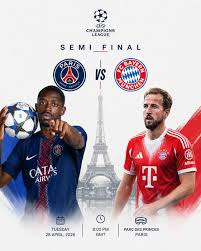
The first legs of the UEFA Champions League semifinals began on April 28, 2026, with two ties that promise tension from the opening whistle to the final minute. Atletico Madrid faced Arsenal in one marquee matchup, while PSG met Bayern Munich in another, giving fans a semifinal lineup rich in style, history, and unresolved ambition.
Four clubs, one prize
At this stage of the competition, there is no room for comfort. Every misplaced pass can shift the balance of an entire tie, and every goal can echo for days. The semifinals bring together clubs with different identities but the same hunger. Atletico arrive with their familiar edge and defensive discipline. Arsenal bring rhythm, width, and a growing sense of belief. PSG carry the weight of expectation that has followed them for years. Bayern Munich bring pedigree, structure, and the habit of turning pressure into performance.
That combination gives this round a rare depth. These are not just two matches. They are four competing visions of how elite football should be played. One side relies on control through possession. Another trusts compact lines and counterattacking force. Others lean on speed, pressing, and individual brilliance. When those styles collide, the game often becomes less about theory and more about nerve.
Atletico Madrid versus Arsenal
The meeting between Atletico Madrid and Arsenal is especially compelling because it pits two teams with very different emotional rhythms against each other. Atletico tend to thrive in matches where patience, friction, and discipline matter. They are comfortable making the game uncomfortable. Arsenal, by contrast, often seek to impose tempo early, move the ball quickly, and force opponents into defensive errors before they settle in.
For Arsenal, this kind of semifinal is a measure of maturity. The club has worked hard to reestablish itself among Europe’s top contenders, and the Champions League now offers the kind of pressure test that reveals whether that progress can hold under the brightest lights. For Atletico, the tie is another chance to prove that their method still works at the highest level, especially against a team that will want to play with urgency and confidence.
Fans will watch the middle of the pitch closely. That is often where Atletico slow games down and where Arsenal try to accelerate them. If Arsenal can move the ball through congestion and create chances in the half spaces, they may be able to dictate the first leg. If Atletico drag the tempo into a more physical, emotionally charged contest, they can make the tie far more difficult than Arsenal would prefer.
What could decide the tie
- Arsenal’s ability to break Atletico’s compact shape.
- Atletico’s success in turning defensive pressure into counterattacks.
- Set pieces, which often become decisive in tightly managed European knockout ties.
- The composure of each team in the final 20 minutes of the first leg.
PSG versus Bayern Munich
The PSG versus Bayern Munich semifinal carries a different energy, one rooted in star quality, tactical complexity, and the expectation of goals. PSG have long been associated with attacking flair and heavy investment, while Bayern bring a more institutional sense of certainty, built around pressure, structure, and years of success in this competition. When those forces meet, the result can feel both elegant and ruthless.
PSG will want to use pace and direct movement to unsettle Bayern’s defensive line. Their challenge is not usually in creating opportunities, but in sustaining concentration across both legs and avoiding the lapses that have haunted them in past European campaigns. Bayern, meanwhile, are unlikely to be intimidated by the occasion. Their experience in knockout football gives them a calm edge, and they know how to keep a semifinal from becoming chaotic when that suits their plan.
This tie may hinge on transitions. PSG can be devastating when they recover the ball and attack space quickly. Bayern can be just as dangerous when their pressing forces a turnover high up the pitch. That means every loose touch, every overcommitted full back, and every poor first pass could become a major moment. In matches like this, control is often an illusion.
The atmosphere matters
Champions League semifinals do not only unfold on the grass. They live in the noise, the color, and the emotional pressure that fills each stadium. The first leg has a unique feel because it carries both opportunity and caution. Teams want an advantage, but they also know the second leg still waits. That tension produces a special kind of football, one where emotion can surge one minute and tighten the next.
Supporters understand this better than anyone. For them, the semifinals are a season condensed into a few hours. The songs begin early, the nerves spread quickly, and every decision from the bench seems larger than life. A Champions League night can make even familiar stadiums feel transformed. The floodlights, the anthem, the close up focus on each face before kickoff, all of it creates the kind of atmosphere that reminds us why this competition remains one of football’s great global rituals.
For players, too, the pressure is unmistakable. Some rise into it. Others shrink from it. The semifinal stage is where reputation often becomes legacy. A dazzling performance here can define a career chapter. A mistake can linger far longer than the ninety minutes it took to make.
Why this semifinal round matters
The Champions League semifinals are more than a route to a trophy. They are a collision between philosophy, preparation, and belief. Clubs spend years building squads that can survive these evenings. Coaches design systems with this stage in mind. Fans live for the possibility that one spring run can alter a club’s history. That is why the stakes feel so intense now.
For Arsenal, the semifinal moment carries the hope of continental validation. For Atletico Madrid, it offers another chance to prove the durability of their competitive identity. For PSG, it is part of a longer quest to turn resources and talent into European glory. For Bayern Munich, it is about maintaining the standard that has made them one of the most feared clubs in the game.
All four teams know that the first leg rarely decides everything, but it can shape everything that follows. A clean sheet, an away goal, a late equalizer, or a tactical adjustment that works under pressure can change the emotional terms of the second leg. That is why every minute matters and why the margins are so thin.
What to watch next
In the coming days, analysts will dissect the tactical choices, individual matchups, and bench decisions that define these games. But the most important question remains simple. Who can hold their nerve when the match becomes difficult? At this level, talent alone is not enough. The teams that advance are often the ones that survive the moments when their structure breaks and they must rely on instinct, unity, and belief.
That is the beauty of the Champions League semifinals. They do not simply reward the best team on paper. They reward the team that can live most fully inside the pressure of the occasion. Atletico Madrid, Arsenal, PSG, and Bayern Munich each have their own version of that challenge now. The first legs have begun, and with them comes the familiar sense that football is about to produce another night, or two, that will stay with us long after the final whistle.