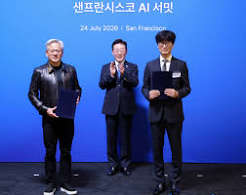
NAVER, Brookfield, and NVIDIA have announced a $10 billion partnership to expand South Korea’s sovereign AI compute infrastructure, a move that could reshape how the country trains and runs large scale artificial intelligence systems. The project plans to grow capacity from 55 megawatts to 200 megawatts using NVIDIA’s Vera Rubin platform, signaling that South Korea is aiming not just to participate in the AI race, but to control more of its own digital foundation.
A larger bet on AI sovereignty
This announcement goes far beyond a simple data center expansion. The phrase sovereign AI has become one of the most important ideas in global technology because it speaks to a nation’s ability to host, train, and govern its own AI systems without relying entirely on foreign infrastructure. For South Korea, that means strengthening the country’s position in a field that increasingly touches manufacturing, software, public services, finance, media, and national security.
By backing a major compute buildout inside South Korea, the partnership is making a direct statement about scale and independence. The planned increase from 55 megawatts to 200 megawatts shows this is not a pilot project. It is industrial infrastructure on a national level. The broader goal is to give Korean enterprises and institutions access to the computing power needed for frontier AI work while keeping more of that capacity anchored at home.
Why the scale matters
AI is often discussed in terms of models, apps, and chatbots, but those experiences depend on physical systems that are expensive to build and operate. Massive GPU clusters need electricity, cooling, networking, and carefully managed facilities. That is why this partnership matters so much. It is not simply about software innovation. It is about the metal, power, and real estate that make modern AI possible.
The move to 200 megawatts suggests South Korea is preparing for heavy workloads tied to training and inference, the two pillars of large model deployment. Training requires enormous compute resources to build models in the first place. Inference is the ongoing process of running those models for users and businesses. A strong domestic infrastructure can support both, which means faster response times, more predictable access, and less dependence on distant cloud regions.
NAVER’s strategic role
NAVER is central to the story because it already occupies a major position in South Korea’s internet and cloud ecosystem. Its involvement gives the project local credibility and a built in understanding of Korean digital markets. That matters in sovereign AI, where the technical buildout has to align with language, regulation, enterprise demand, and national priorities. A homegrown platform operator can help ensure the infrastructure serves domestic needs first rather than simply copying a foreign cloud model.
For NAVER, the partnership also represents a chance to move deeper into global AI infrastructure at a moment when every major technology company is trying to secure its place in the next computing cycle. The scale of the investment shows that NAVER sees AI not as an add on service but as a core platform layer. That is an important distinction, because companies that control compute will likely have more influence over the products and services built on top of it.
Brookfield brings capital and infrastructure expertise
Brookfield’s role is equally important. As a major infrastructure investor, it brings experience with long duration assets, power systems, and large scale financing. AI infrastructure is capital intensive, and the economics are closer to energy and industrial buildouts than to ordinary software development. Brookfield’s participation suggests the project is being treated as a durable asset class, not a speculative tech bet.
That combination of capital and operational discipline could help the partnership move faster than a purely internal corporate project. AI factories require coordination across land, power, network connectivity, and hardware procurement. Investors who understand infrastructure can help manage those dependencies. In that sense, Brookfield is not just writing a check. It is helping turn a strategic idea into a physical operating system for AI.
NVIDIA’s hardware advantage
NVIDIA remains the most important technology enabler in this partnership because the entire project depends on its accelerator ecosystem. The Vera Rubin platform is expected to sit at the heart of the expansion, giving the infrastructure the compute density needed for demanding AI workloads. That matters because model performance is only as good as the underlying hardware stack, and the biggest AI players are racing to secure reliable access to top tier chips and networking.
By anchoring the buildout around NVIDIA technology, the project aligns South Korea with one of the dominant platforms in global AI development. It also sends a signal to local enterprises and researchers that the infrastructure is being designed for serious production use, not just demonstrations. In a market where compute shortages can slow innovation, having a stable and scalable hardware base can be a decisive advantage.
What South Korea gains
For South Korea, the potential benefits are wide ranging. A stronger domestic AI compute base can support startups, large enterprises, universities, and public sector projects. It can help Korean companies develop language specific models, industrial AI systems, and customer facing tools without sending sensitive data or critical workloads abroad. That may become increasingly important in sectors where data governance and latency are just as important as raw model quality.
The project may also strengthen South Korea’s place in the regional AI economy. Countries across Asia are racing to secure their own digital infrastructure, and compute capacity has become a geopolitical asset. Nations that can host more of their own AI stack may have greater control over innovation, regulation, and competitiveness. This investment positions South Korea to remain one of the most advanced technology hubs in the region.
A signal to the global market
The scale of the $10 billion commitment sends a message well beyond Seoul. It tells the market that sovereign AI is moving from policy talk to actual capital deployment. That shift matters because many governments have started discussing AI independence, but far fewer have backed it with infrastructure at this scale. When a project of this size lands, it changes expectations about what national AI strategy can look like in practice.
It also shows that the next phase of AI competition may be defined less by consumer apps and more by access to compute. The companies and countries that can secure reliable infrastructure will have more room to innovate. Those that cannot may find themselves constrained by supply, cost, or dependency. South Korea’s new AI factory plan suggests the country intends to stay near the front of that race.
What to watch next
The immediate questions are practical. How quickly will the 55 megawatt phase come online? How will the 200 megawatt expansion be powered and cooled? Which Korean companies, public agencies, and research institutions will get access first? These details will determine how much of the investment becomes real economic value rather than just a headline number.
For readers looking to track the companies involved, the official corporate and industry pages for NAVER, Brookfield, and NVIDIA provide the clearest starting points for corporate context and technical background. What matters now is execution. If this buildout proceeds as planned, South Korea will not just have more AI infrastructure. It will have a stronger claim to shaping the future of sovereign computing itself.