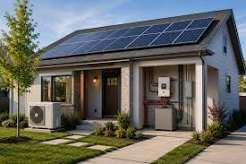
Homeowners across several regions are entering a new phase of the clean energy transition as governments and energy authorities expand financial support for home renovations, efficient heat pumps and solar power systems. The policy direction is increasingly focused on making older homes consume less energy while helping households produce more of their own electricity. For families facing high heating and cooling bills, the changes could turn energy efficiency from a long term ambition into a practical household investment.
Why Home Energy Retrofits Are Gaining Momentum
A home retrofit can involve much more than installing solar panels. It may include insulation, better windows, improved ventilation, efficient heating equipment, smart controls, battery storage and rooftop solar generation. The goal is to reduce the amount of energy a property needs while improving the performance of the systems that provide heating, cooling and hot water.
That approach is becoming increasingly visible in public policy. The European Commission has been developing financing measures designed to address the high upfront cost of building renovation and energy efficiency improvements. Its 2026 energy efficiency financing package also promotes one stop services that can help homeowners navigate technical, financial and administrative issues involved in renovation projects. :contentReference[oaicite:0]{index=0}
The financial challenge is significant. The Commission estimates that European Union and national public funding for energy efficiency is still far below the investment needed for building renovation. That gap has encouraged policymakers to consider grants, private financing, favorable loans and other mechanisms that can make improvements easier for households to afford. :contentReference[oaicite:1]{index=1}
Heat Pumps Move Closer to the Center of Home Energy Policy
Heat pumps are receiving particular attention because they can provide heating and cooling using electricity rather than relying directly on fossil fuels. Their performance depends heavily on the building itself, local climate, electricity prices and the quality of installation, which means successful adoption requires more than simply replacing an old heating system.
The European Commission’s Heat Pump Accelerator Platform has been examining ways to reduce equipment and installation costs while improving market conditions. The platform includes public authorities, energy agencies, installers, financial institutions, utilities and other organizations working on deployment, training and research. :contentReference[oaicite:2]{index=2}
New financing approaches are also becoming part of the conversation. The European Commission’s 2026 Electrification Action Plan encourages measures such as financial incentives, social leasing and other financing models intended to reduce the initial cost of electrification technologies. Heat pumps, photovoltaic systems and residential batteries are among the technologies identified for potential support. :contentReference[oaicite:3]{index=3}
Solar Power Is Becoming Part of Building Policy
Solar panels are also moving from an optional household upgrade toward a more integrated part of building policy. The revised European rules for building energy performance are designed to increase the use of solar photovoltaic and solar thermal systems on buildings where they are suitable and technically and economically feasible.
The European Commission says new residential buildings in the European Union will face solar installation requirements from 2030 where installations are suitable and feasible. Existing residential buildings are not automatically required to receive solar panels under the rules, although countries can establish national or local requirements connected to renovation support. :contentReference[oaicite:4]{index=4}
This distinction matters for homeowners. A subsidy program may encourage a solar installation without making it legally mandatory. Requirements can also vary according to building type, location, structural conditions and national implementation. Homeowners therefore need to check the rules that apply specifically to their property rather than assuming that an international policy announcement creates an immediate requirement.
Smart Homes Are Becoming Part of the Retrofit Conversation
The next stage of residential energy efficiency is increasingly connected to smart technology. A modern retrofit can combine a heat pump with smart thermostats, solar generation, batteries, energy monitoring and automated controls.
These systems can work together to change when a home consumes electricity. A household with rooftop solar, for example, may be able to use more electricity during periods of strong solar production. Smart controls can also help coordinate heating, cooling and hot water demand with household routines and electricity availability.
For homeowners, the practical benefit is not necessarily having more technology for its own sake. The value comes from using technology to make energy consumption easier to monitor and manage. A simple display showing household electricity production and consumption can make previously invisible energy use much easier to understand.
Governments Are Also Trying to Solve the Upfront Cost Problem
The biggest obstacle for many families is not whether a heat pump or solar system can work. It is whether they can afford the initial investment.
A household may understand the potential benefits of insulation, efficient heating and solar generation while still deciding that the upfront cost is too high. This is why the expansion of subsidies and alternative financing mechanisms is becoming central to retrofit policy.
One example comes from Greece, where an approved Social Climate Fund plan includes billions of euros in investment between 2026 and 2032. The program includes support for energy efficiency improvements, heat pumps, solar water heaters and housing measures aimed at vulnerable households. :contentReference[oaicite:5]{index=5}
Ireland has also used grants and other measures to support heat pump adoption, including higher support for installations that form part of deeper renovation projects. A 2026 government budget document describes grants, tax measures and retrofit services designed to increase the number of homes receiving energy upgrades. :contentReference[oaicite:6]{index=6}
What a Homeowner Should Check Before Applying
More financial support does not mean every property will qualify for every program. Eligibility can depend on household income, property type, existing heating equipment, energy performance, location, installer qualifications and the technology selected.
Homeowners considering a retrofit should first establish how their property currently uses energy. An energy assessment can identify where heat is being lost and whether insulation or ventilation improvements should happen before installing new equipment.
A sensible renovation plan may consider several elements together:
- Building insulation and air sealing
- Efficient heating and cooling equipment
- Solar photovoltaic generation
- Smart thermostats and energy controls
- Battery storage where financially suitable
- Efficient hot water systems
- Qualified installation and maintenance
The order can matter. Installing a large heating system in a poorly insulated building may not produce the same results as reducing heat loss first. Likewise, the ideal solar system depends on roof orientation, available space, electricity consumption, local rules and the household’s future energy needs.
The Human Side of the Retrofit Boom
Behind every renovation statistic is a household trying to make a difficult financial decision. For an older homeowner, replacing a heating system can feel like a major disruption. For a young family, the challenge may be finding enough money to renovate while also paying a mortgage and other household expenses.
That is why accessible advice can be almost as important as financial assistance. A grant that requires complicated applications, several technical assessments and multiple contractors may remain out of reach for households without the time or confidence to navigate the process.
European policy is increasingly recognizing this issue through one stop renovation services. The European Commission has promoted these services as a way to provide homeowners with practical technical, financial and administrative assistance. :contentReference[oaicite:7]{index=7}
More Investment Does Not Mean Every Home Needs the Same Solution
There is no single retrofit package that works equally well for every home. A detached house in a cold climate may have very different requirements from an apartment in a warm region. Roof condition, electrical capacity, insulation quality, local weather and household energy habits can all change the economics of an installation.
Solar panels may be highly suitable for one property while another may have limited roof space or structural restrictions. A heat pump can be an excellent choice for some buildings, while others may require insulation or heating distribution improvements before the system can perform effectively.
This is also why the expansion of incentives needs to be accompanied by qualified installers and reliable consumer information. The European Commission’s electrification plan identifies training and certification for professionals as part of the broader effort to expand building electrification. :contentReference[oaicite:8]{index=8}
A Broader Shift Toward Lower Energy Costs
The current policy movement is larger than a campaign to sell solar panels or heat pumps. Governments are trying to reduce energy demand, improve housing conditions, strengthen energy security and lower household exposure to volatile energy costs.
Building renovation can also produce benefits that homeowners experience directly. Better insulation can make rooms more comfortable during extreme temperatures. Efficient heating can provide more predictable indoor conditions. Solar generation can reduce dependence on electricity purchased from the grid, depending on local regulations and household consumption patterns.
The transition will still require substantial investment. Public subsidies alone are unlikely to cover the full cost of renovating millions of homes, which is why policymakers are increasingly discussing loans, private finance, leasing arrangements and other models alongside direct grants.
What the Global Retrofit Expansion Could Mean for Homeowners
The direction of policy is becoming clear: energy efficient homes are receiving greater attention, and financial programs are increasingly being designed around the technologies that can reduce energy consumption and support electrification.
For homeowners, the most useful response is not to rush into the newest technology. It is to evaluate the property carefully, understand available incentives, compare qualified installers and calculate the total cost over the expected life of the equipment.
The strongest retrofit decisions are likely to be those that connect several improvements rather than treating each device as an isolated purchase. Insulation can reduce heating demand. A properly sized heat pump can provide efficient heating and cooling. Solar panels can generate electricity. Smart controls can help coordinate consumption. Together, these measures can change the way a home produces, uses and manages energy.
As international housing and energy authorities continue expanding support for greener buildings, the meaning of a modern home is also changing. The house of the future is increasingly being viewed not simply as a place that consumes energy, but as a building that can use less energy, manage demand intelligently and generate part of what it needs.